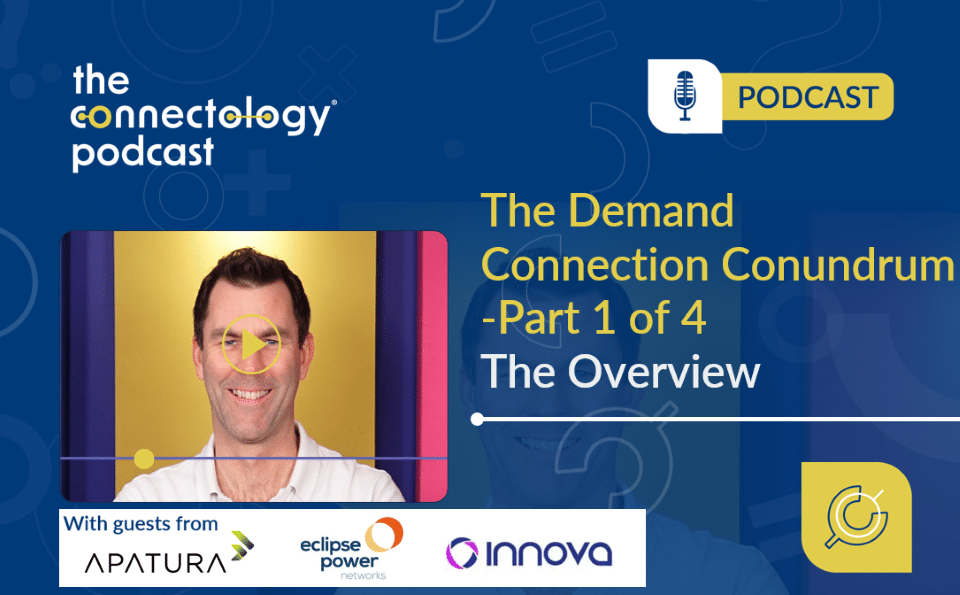
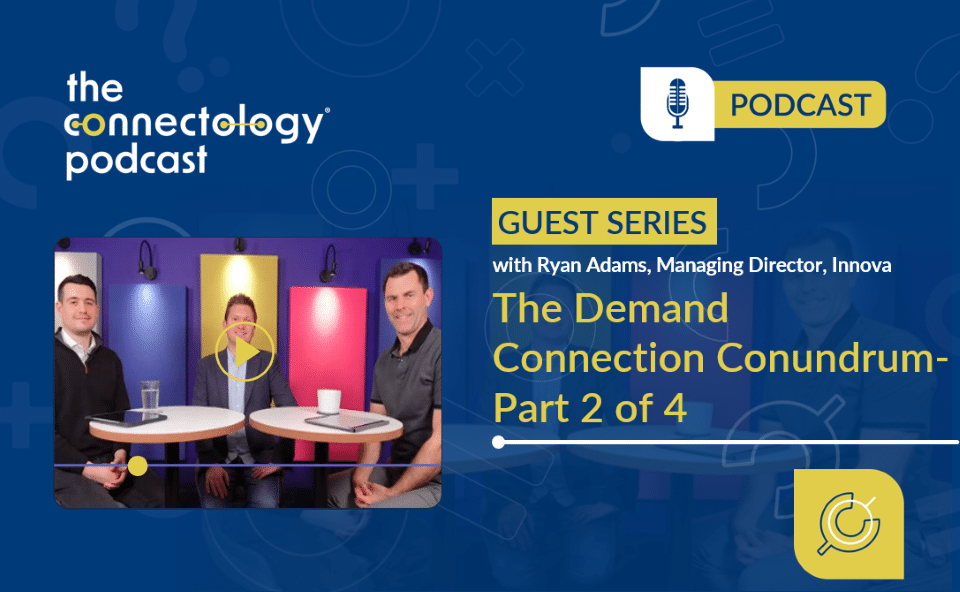
Podcast: The Demand Connection Conundrum – part 3 of 4 with Spencer Thompson, Eclipse Power
Summary:
In this episode, part 3 of a 4-part series, Connectologist® Pete Aston and colleague Alex Ikonic speak with Spencer Thompson, CEO of Eclipse Power Limited, exploring innovative solutions to transmission-level demand connection challenges.
The core challenge:
- Data centres need three to four-year connection timelines but, unlike renewables, they’re competing directly with Europe for investment—making UK speed critical.
Key issues:
- UK competitiveness crisis – data centres can choose European locations if UK proves too slow
- Location paradox – need London/M4 corridor proximity for latency, but grid capacity there is scarcest
- TO inconsistency – NGET doesn’t build out to sites; Scottish TOs do
- BCA limitations – one legal entity per agreement complicates hybrid projects
- Leadership vacuum – unclear who owns decisions between Ofgem, DESNZ, and NESO
Three pathways forward:
- Case-by-case exemptions for minimal transmission asset projects
- Independent Transmission Operator licenses for “last mile” connections
- Demand license regime mirroring generation licenses, particularly for hyperscalers
Spencer’s six-month goal:
- Industry consensus on multiple connection pathways with clear governmental leadership, applying the urgency demonstrated in Connections Reform.
Transcript:
00:01:19 – 00:01:29 – Pete Aston
Hello and welcome to another Roadnight Taylor Connectology® podcast. I’m Pete Aston, one of the engineers here at Roadnight Taylor, and I’m joined by my colleague Alex Ikonic and Spencer Thompson from Eclipse. So, welcome.
00:01:30 – 00:01:31 – Spencer Thompson
Thanks, Alex, Pete, great to be here.
00:01:31 – 00:01:51 – Pete Aston
Yeah, nice to have you. Now this is the second session that we are running with sort of various key industry players on the subject of demand connections and sort of all the complexities that are sort of really coming out the woodwork around those.
But before we get into the, the meat of that discussion, can you just sort of give us a quick introduction to Eclipse and then your role within the business?
00:01:52 – 00:02:38 – Spencer Thompson
Yeah, so I’m the CEO of Eclipse Power Limited, which is the group entity if you like. We’re owned by a fund that’s managed by the Octopus Group. So, we have, that’s the affiliation, and we’re able to kind of reach into the Octopus Group to help on various different aspects in the industry, but the core of Eclipse is the IDNO business that operates all around England, Wales and Scotland.
We have a private networks business called Eclipse Power Optimize, which also includes microgrids, which is a real interesting technical challenge for the industry. And we also have a grid consultancy called Eclipse Power Solutions when, you know, some of my colleagues and recently we’ve been testing our thinking and exporting the model into Europe as well to see if we can solve similar grid problems because we’re all industry people at heart and we love trying to come up with innovative ways to connect to the grid.
00:02:39 – 00:03:01 – Pete Aston
Brilliant, thanks for that. So when looking at sort of the, this demand connection space, and I guess, you know, demand connections have, I guess, have historically been distribution level, but seeing a lot more of them there in the queue, certainly at transmission level; what are you seeing in eclipse of some of the, key problems that are starting to sort of come out and, and present themselves?
00:03:02 – 00:03:57 – Spencer Thompson
Yeah, it’s a good question. So, I think, firstly, this is a bit like Connections Reform brewing away in the background, so all the renewables that been building up over the last few years. We’re now at the heart the storm of Connections Reform as you’re very well aware, I think our challenge now as an industry is you’ve got the same kind thing happening with data centres and with other large demand customers, and as an industry, we need to find ways to meet that demand and connect.
The key challenges are grid capacity. The key challenges are being able to deliver to the timelines that they need, and you’ve got a growing queue every day and how, how do we solve that as an industry? Hopefully more speedily than the Connections Reform and the challenges also for UK PLC. We’re all, you know, different maybe from renewables; we’re actually competing with the rest of Europe. So how can the UK be attractive for data centres versus other countries in Europe and that, that’s definitely a challenge for us.
00:03:58 – 00:04:14 – Pete Aston
Yeah, and is that, so you mentioned speed just now. Do you think that speed issue is one of the, one of the main issues? I mean, you know, and what are you seeing around that timescale issue with data centres? Because I hear various things, know, like, things like if you’re not connected by 2030, that’s it, you know, you’re out – I don’t know what you are hearing?
00:04:15 – 00:05:22 – Spencer Thompson
Yeah, I think there’s a bit of rhetoric around it has to start with the 2020 something, yeah there’s definitely that.
If you look at the bigger data centre connections, they need two to three years to build and connect. So, they’re obviously looking today, looking for connections in 28, 29, hopefully before 30. The data centre markets quite varied. You know, you’ve got your hyperscalers, you’ve got a kind of, you’ve mid, 50 to a hundred megawatts, and then you’ve got your micro-ones as well; so, each have a different demand and have different requirements grid. So, it is a T and D problem at certain, the certain levels in distribution, the smaller end, that can be connected probably the BAU process for connecting. But the bigger ones are, are grabbing that demand and there’s a lack of capacity in the network that’s problem. And if you add that the Connections Reform and the renewable situation, you know, it’s even more challenging. So, and the ability for the industry to be agile, to make that demand is the challenge. But certainly, from an investment perspective, we hear from data centre customers that, yeah, they want to connect these before 2030.
The challenge in some cases, it’s not going to happen. Yeah. So, we’ve got to be realistic, but we need change some of the rules to help these projects get connected…
00:05:23 – 00:05:46 – Alex Ikonic
Yeah, and I think one of the things you mentioned there is quite a point in that there is so much variation in demand projects. So, even just within data centres, but also other types of demand, you know, hydrogen and others as well. So, coming up with that set of rules is going to be very challenging. Yeah, perhaps even more so than, for renewables and Connections Reform, which we all know was very challenging.
00:05:47 – 00:06:15 – Spencer Thompson
Yeah, and it kind of reminds me of in the early days of the renewables where you were connecting separate solar, separate battery and then it became, can we co-locate those? And then there was green hydrogen for a while; it’s kind of similar here where you’ve got data centres, but they also need backup generation.
So, is it an OCGT? Can you use some battery? Can you use some other forms of, of generation, so you, you’ve got this co-location, or hybrid is the term at the moment that is a challenge for the industry. How can you help customers like that connect so it’s not just a data centre demand point.
00:06:16 – 00:06:39 – Pete Aston
And have you got any thoughts around what makes a viable say data centre connection because that seems to be like, you know what Ofgem is starting talk about now is in looking at sort of queue formation and so on, within that demand is, is viability. So, do you have any around what might make a viable data centre project?
00:06:40 – 00:08:20 – Spencer Thompson
I think in a perfect scenario, right, you can get grid within three to four years. The infrastructure costs are, you know, not, unreasonable is probably the wrong but depending where you want to connect in the UK will of course lead you to a certain level of infrastructure required. So, you know, we know that data centres want to be close to London or the M4 corridor, but that an area where grid capacity is really scarce, you know, so you can see the data centre community now looking further out across the UK. You hear about AI growth zones, when will the government declare those? You hear about availability zones; that’s the language from the data centres; and this is different to the Connection Reform where you’re thinking about first ready network need. first served, actually, this is a network point. This is where does the data centre need to be to minimize the latency delays, you know, on the fibre network an example.
So, the viability, there’s going to be, you know, emerging already, there are availability zones around the country. And I think the government, the industry need to support those. And then how can you accelerate those connections for those data centre companies and of course bring battery or backup generation as required, you know, that’s really going to drive it. The cost, it’s a different kind of investment model to renewables. So, there is more flexibility, I think, with the data centre community of how we, how you connect. And also, if you’re talking hyperscaler they would also say, well, we’d be willing to own parts of the electricity network to get these connections made.
Yeah, and that’s, we should consider all options really. And we do need Ofgem, DESNZ, DESIT, NESO, et cetera. We need all these parties to come together to come up with some different solutions.
00:08:21 – 00:08:44 – Pete Aston
Yeah, so what’s the key problem with sort of, so for these larger, transmission connections, where, you know, you may be four, 500 plus megawatts of demand. What are some of the key issues though, in terms of that grid connection bit? Because I know there’s issues with, you know, what sort of voltage level of network demand customers can build out and that sort of thing.
00:08:45 – 00:09:37 – Spencer Thompson
Yeah, because if you’re trying to connect four or 500 megawatts of distribution, that’s quite rare, it’s invariably going to be transmission. And then at that size, of course, you probably need grid infrastructure, and significant cost there too. And then you’re into a lead time of how quick can you build the infrastructure, which is a similar issue to large renewable connections, yeah. So that does lead you down. This is going to be 3, 4, 5 years plus before you can connect those big hyperscalers for the mid, for the mid region, for the data centres, it’s a different, a different discussion, but at transmission you’ll see it for the TO, NGET, England, and Wales – they don’t build out to the data centre park where Scotland, you know, they will build out in with SPT and so you’ve got two solutions there.
But, you know, agility is the point here, you know, in the likes of NGET in England and Wales, because they don’t build out, that means you’ve got some difficulties around the rules of owning networks. And that, that’s the key issue here, think, that we could solve with some different ways of, connecting.
00:09:58 – 00:10:26 — Pete Aston
Yeah, and so there is that key issue with network ownership, isn’t there? So, the current licensing rules go if you’re a gen, if you’ve got a generation license you can own transmission level stuff, network stuff, but if, if you are a demand customer, you can only own distribution level kit. And so, so there’s this mismatch the moment.
00:10:27 – 00:11:13 – Spencer Thompson
Yeah, and you know, the rules need to change around that. But also if you think about, the BCAs, the bilateral connection agreements, you can only have one legal entity at the end of a BCA. And we’ve seen it again in the Connection Reform, you if you’ve got a bunch of, batteries and, solar farms, they each have their own connection, but if they’re owned by separate legal entities, you have to split the BCA – that is a problem that has been looked at. It’s the same for data centres – if data centres need generation, the only way to have a single BCA is to put everything behind the meter.
Now, technically that does work, but of course it does complicate it upstream for the grid companies. So, there can be some rules similar to the reform that we could change to help data connect and own their own networks, either transmission or distribution.
00:11:14 – 00:11:23 – Pete Aston
And so, what are some of the solutions then, do think? Because I know as Eclipse you’ve been exploring a particular option recently alongside of it.
00:11:24 – 00:12:39 – Spencer Thompson
Yeah, so we, we’ve explored two over the last few years, but the current one is a project we have called Future Point Manchester. So that’s a co-development with Carlton Power, who are a long-term developer, been in the industry 20 plus years, and the project in Manchester is, a project connecting into the NGET network; it’s basically next door, there’s no infrastructure required, but there’s a, small amount of transmission assets we’d have to own as a private network, and our Secretary of State submission, has gone in to say, look, we’ve got a net that we can build out, we can build, we can connect a connect a data centre, renewables, battery, OCGT, and also serve smaller local industrial customer connections like, electric HGV hubus you know, so it’s, it’s essentially a giga park. But the idea is if we own that network, we can build quicker and more cost effectively and adopt slightly different technical standards to enable those connections.
And we think it’s quite innovative. It’s quite unique because there’s no infrastructure work required – we have the land, we have the customers, we had the local support of the local MP engagement with GMCA as an example, and, you know, all the stars have aligned for that project to proof of concept that actually we can do this as an industry.
00:12:40 – 00:12:54 – Pete Aston
So, this, so the exemption is saying, can we as Eclipse own what a, is effectively a 400 tool? 275 to 132kV transformer, and it and what, a short bit of cable or something back the main substation?
00:12:55 – 00:14:34 – Spencer Thompson
As you know, your viewers have probably heard, you know, it’s, an interpretation of the Electricity Act, the wholly and mainly. Yeah. And if you look at that network that would connect those customers, there’s a short length of transmission line, less than a kilometre, and then there’s some, transformers. And then you’re into a distribution network. So, the view is this is wholly and mainly distribution. Now there’s two reasons why we’ve gone through a transmission license exemption is one is, it’s more bankable for customers connecting because it gives you certainty that this is license exempt, we can connect, et cetera. The second point is you could interpret this as a distribution network, but you’ve always got the view that at any point in time, government or Ofgem could say, well, we’re not sure whether it is or not, and it becomes disallowed, let’s say, so that’s not as bankable.
The second point here is we’ve designed tariffs for the customers that match local tariffs – so that’s a real plus point; so, they’re market facing and we’re financing the build of this, and we recover those financing costs through the tariffs. So, market facing tariffs, there’s no consumer burden as well, and you’ve no infrastructure costs with grid. So, it’s a really neat solution to help the customers connect quite quickly. And we have a supply chain kind of ready to go as well, you know, so it’s quite a neat solution.
I think the key point is the tariffs make this work for customers. So of course, if we had tariffs that were more expensive, it wouldn’t work for the customer. But the fact you, when they’re doing their benchmarking, they can go, well, this is the local tariff, this is our tariff that’s a tick box and there’s no infrastructure works from NGET which means. Speed wise, you can, you know, the critical path is down us and the data centres to build it in time in three years essentially.
00:14:35 – 00:14:39 – Pete Aston
Yeah well, it sounds like an interesting solution. I think everyone’s really keen to, to see what comes out of it.
00:14:40 – 00:14:41 – Spencer Thompson
Yeah, absolutely.
00:14:42 – 00:14:54 – Alex Ikonic
And do you see that kind of route where it’s a very sort of site specific, you know, exemptions from the licenses being the future? Or do you kind of envisage more, you know, us kind of setting something that’s like a transmission network operator license?
00:14:55 – 00:16:07 – Spencer Thompson
Yeah. Good, good question, Alex. So, I think two things. There’s always the danger of precedent, right? That’s the first thing you get back, and we were in a workshop a few weeks ago with DESNZ and the whole, the whole industry, and we talked about that point. We did say, to be honest, and of course we would say it case by case and the, and the reason why I would say this is we have a small amount of transmission assets and the majority’s distribution, so it fits the wholly and mainly, but with other connections. If it’s mainly transmission, then you can you be transmission license exempt?
It might lead you to your can we create independent transmission licenses? And we went through that three, four years ago with Ofgem; we didn’t quite get to the final hurdle, but the concept was understood by the industry and NGET, NESO and Ofgem at the time. And, you know, we even wrote a paper on how this market work would, which similar to IDNO, no surprise.
So this could be another way to kind of solve the precedent question, where you’re having last mile transmission connections. Allowing customers to connect more quickly and be more in control of their connections rather than waiting for that the TOs accepted to build out when the TOs have got such high volume of work – that’s the other challenge.
00:16:08 – 00:16:21 – Pete Aston
Yeah, and I guess the other thing about TOs building out, and I know you’ve come across this as well, Alex, just that the discrepancy there is between, you know, England and Wales and Scotland, in the way that they do things differently.
00:16:22 – 00:16:41 – Alex Ikonic
Yes, yes. So, like we talked about before, the transition companies build out the network to you; in Scotland and it’s very different in England and Wales, but also in terms of the kind of, wider works and reinforcements, you know, to do with the SQSS, and demand connections, they are bit more stringent than for some generator connections.
00:16:42 – 00:17:33 – Spencer Thompson
Yeah, that’s true, so we should never forget SQSS and I think the point there is you know, it, if it’s Future Point Manchester, there’s no infrastructure work required, great; but if there’s another connection that needs have major infrastructure works, which links to reconstructing overhead lines, you know, that’s going to take a long time; so, you haven’t got the advantage there, and this is why you know the point, going back case by case, it won’t suit every scenario.
So, I think the license exempt suits some scenarios. I think an ITO license would suit others, you know, certainly for the developers that we work with. And if you think of where the developer’s mindset might be, they’re also saying, well, we we’re more agile, we can build quicker and more cost effectively than the electricity entities. So, and that’s true, but of course, making sure we meet the standards is, is also that is very important.
00:17:34 – 00:17:58 – Pete Aston
Yeah.
And do you see any role, because some, another option some people have about is, the government producing a demand license, like similar to the, you know, generation license. And do you see that as a potential route, or is would that just take forever because it’s, you know, government licensing and electricity acts and all that of business?
00:17:59 – 00:18:48 – Spencer Thompson
Yeah, that would be a, another great option, if we could make it happen quick enough, and particularly I think for, let’s say hyperscalers who have large, you know, 500 megawatts plus. If, you know, given the level of involved in those data centres, the cost of grids is a much smaller cost in the scheme things, although it’s critical because you need to get that connection built. So, if there was the opportunity for large demands to have that demand license, just like- that’s got to be a solution, it has to be, you know, and owning their own networks on the basis of they are the only customer connecting, I guess. But to be honest, then you go back to what else might they have behind the meter as well, you know? Because they still need backup generation, but it will be their own generation and everything, so yeah I definitely see that as a solution is how quick can we make it happen.
00:18:49 – 00:19:11 –Pete Aston
Yeah, yeah, yeah. Yeah.
I think we, it feels like we’re sort of coming towards end of the conversation on this, not that there isn’t anything else to talk about, but just time, time is away.
But, if we were to sort of wind the clock forward, six months, what would sort of eclipse’s view be on what the things that you would’ve liked to have changed within six months?
00:19:12 – 00:20:17 – Spencer Thompson
Yeah, I think, you know, in six months, of course, we’d like to see Future Point Manchester starting to be designed and built. I think in terms of the industry, you know, I would want to have seen, you know and it’s been really good because if you look at Connections Reform, it’s taken a while get here – it’s here now we’re, we’re right in the middle of it and things are happening; so that’s great to see. Can we do that more quickly for demand?
So as an industry in July next year before we take our holidays, you know, you know, led by the industry Ofgem, DESNZ, et cetera, and NESO, we have a solution for connect connecting demand. We’ve prioritized them, we’ve changed the rules that allow them to connect more quickly, we’ve looked at all the various different options and we’ve gone, yes, we can do, you know, ITO, we can do transmission license exempt some things in the pipeline now for demand licenses – that would be a great result six months and it’s very possible because I’ve certainly seen in the last two or three months the pace the industry has moved on the, on the, on reforming the queue for renewables. And it’s one of those things, you know, utilities are really good when there’s an emergency, right, it’s an emergency, come on, we can do this. That’s where I’d like to see, you know?
00:20:18 – 00:20:38 – Pete Aston
Yeah, and I guess the final question is, have you got any view to, who actually owns that process? Because I know you want to, you’re in that sort of meeting a few weeks back, I think know Ofgem was there, NESO, DESNZ, you know, industry developers and so on, you know, and sort of, you know, IDNO’s like yourselves as well.
00:20:39 – 00:21:30 – Spencer Thompson
It’s an interesting one because when we started on our path with Future Point Manchester we thought, well, we need to speak to everybody; but that takes effort and, and exactly that question, who does make the decision? And we did quickly got to this has to go Secretary of State. That was the first point. But of course, the Secretary of State is going to ask DESNZ, Ofgem, NESO, et cetera. You know, I’m seeing more and more that DESNZ seem to be leading on some of these policy issues, which is fantastic see.
The industry does need some leadership here. So, would it be great to see that Ofgem, DESNZ, NESO are really working closely together in a combined effort? Personally, I’m not, not too bothered. Who leads on that, but you know, because they’ve all got a long list of things they need to solve, but whichever one provides a leadership you know, let’s do that because it is hard to say who’s making the decision, and it feels like you have to hit everybody to get a decision. And decision by committee is really tough.
00:21:31 – 00:21:33 – Pete Aston
Yeah, yeah or it falls in that black hole.
00:21:34 – 00:21:34 – Spencer Thompson
Yeah, yeah exactly.
00:21:35 – 00:21:47 – Pete Aston
Brilliant, Spencer, Alex, that was fantastic, thank you so much, it has been brilliant to talk through it, thank you everyone listening as well, and we do hope, you will join us for the next podcast, and thanks very much and goodbye.