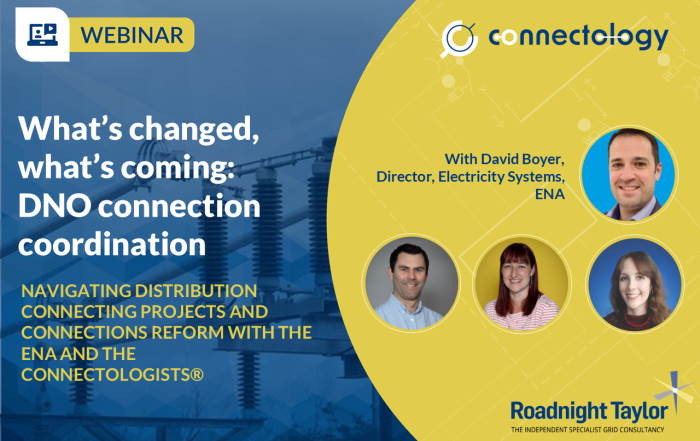
What’s changed, what’s coming: DNO connection coordination’ with David Boyer, ENA
Summary:
The connections landscape keeps evolving. Reform of the queue for transmission capacity is underway. Application processes have changed. Queue management guidance has been updated.
Join the Connectologists® and David Boyer, Director, Electricity Systems at Energy Networks Association, as they explore connection reform impacts and DNO coordination.
The session will discuss:
- what are the primary changes we have seen for distribution connecting projects through 2024 and 2025
- which recent changes are still to be seen by projects (and what to watch for)
- where could DNO coordination strengthen your future connections
- what are some recommended solutions DNOs and ENA could develop
This session looks both at what’s changed over the past 18 months and what’s coming next, focusing on practical coordination challenges facing low carbon generation, energy storage, data centres, industrial and real estate projects. It combines ENA’s system-level perspective with the Connectologists’ frontline project experience.
Transcript:
00:00:00 – Pete Aston: It’s, lovely to have everyone here. I’m Pete Aston, one of the engineers here at, road Night Taylor, and I’m joined this morning by two of my colleagues, Nikki Pillinger, who’s been on a number of webinars with me already over many years.
And for excitingly for the first time, Alex Ikonic, our newest starter joining us on this webinar. So, so welcome Nikki and Alex. And it’s even more exciting this morning that we’re joined by David Boyer of the ENA, who’s Director of Electricity Systems. So welcome David.
Lovely to have you on board. And I’m going to get David to do a bit of an intro on himself, shortly. But before David does that, let me just, sort of introduce you to, the session this morning and the way we’re going to run it. So I’m just going start sharing screen so I can put up the first slide for us just to show the title.
So, so what we’re focusing on this morning is DNO connection coordination, and specifically around the DNOs and the ENA.
So, so what we’re not going to be really touching on much this morning is connections form. I know lots of listeners, attendees will be very excited or maybe concerned about connection reform. Notifications are coming out this week around whether it’s going to be gate one or gate two offers, but, but we’re not here to talk about connection reform primarily.
Maybe we’ll touch on it a few times as we, as we go through. But, I don’t think we’re going to be able to answer loads of questions about connections from specifically because we probably don’t know the answers. That’s really a NESO thing. Say for example, we are not going to be able to sort of talk specifically around whether schemes are going to get a gate one or two offer.
We don’t know in the first, next application window is going to open for connections, reform and so on. So, unfortunately we’re not going to be able to touch on that, but really looking at co connection coordination, with the DNOs and the ENA. If we do get questions that relate to question, connections reform that we think are worth passing onto NESO, we’ll sort of bundle them up and pass them on afterwards.
So that NESO can, can get that learning. So in terms of questions, we’ve got the, the G and A function enabled. So, so please put any questions into the Q and A and we’ll be coming onto those questions a bit later on in the session. So we’d love to have your participation, and sort of hear your questions, especially with David from ENA being with us today.
So, before we go onto anything else, David, if you could, sort of briefly introduce yourself and your role within ENA, that would be great. Thanks.
00:03:10 – David Boyer: Okay, and good morning all. So my name’s David Boyer. I’m the Director of Electricity Systems for the Energy Networks Association. So we, as you, you may well know, we are the trade association that represents all of the electricity networks, distribution and transmission in Britain.
And, you know, my role is Director of Electricity Systems. So what that entails is all of the technical or collaborative reform programs, operational initiatives, etc that the networks all seek to do jointly, as a collective me and my team work with them to, to provide that coordination and that convening and that delivery kind of structure to the activities they want to progress together.
That sits across a number of areas such as technical codes on distribution and, and engineering recommendations and resilience activities. But also very much, since I’ve been in role, the, the connections focus has been quite a significant part of that. So that’s a very quick, introduction and good morning.
00:04:08 – Pete Aston: Thanks David so much. And I possibly didn’t say, but thank you everyone, for taking an hour out of your day to sort of join us on this webinar. It’s brilliant to have so many from, from the industry joining, joining us today. Be before we get into the actual questions, that we want to sort of go over today, we do have a Slido poll that we’d, really like to, to get your involvement with.
So, hopefully that’s, you can see on the screen now the Slido questions. So the, the first of these three questions is actually open now. So if you use the QR code or the Slido hashtag code that you can see on the screen, we’ve got question one open at the moment, which is, which category best describes your business.
The other two questions will be open, as we go through the session. We put, pop them on the screen so you can see what’s going to be coming, because it’d be great to have, your feedback on these, on these particular questions. And then we’ll, what we’ll try and do is put some, put like a word cloud up at the end of the answers, that we get back, just so that everyone can see the responses to the questions.
So, so whilst, whilst you’re doing that, what we’ll do, we’ll go onto the first question, the preset questions that we’ve got, which I’m going to, I’m going to pop over to David. So how, how did the DNOs relate to the ENA, David, and how does the ENA differ from NESO? So, fairly basic question, but it’s possible that some, attendees might not quite have understood the sort of nuances around that.
00:05:47 – David Boyer: Sure. And it’s a complicated sector, so it is good to kind of, to outline. So like I mentioned, the, the DNOs as well as the TOs are members of the ENA as a trade association. So we represent them, we, we work on their behalf, and at their direction. So that is the role we play. As it kind of started to get into in the intro.
Me and my team in particular, we work to, coordinate and, and convene and drive forward the projects they want to do collaboratively. The connections is very much the, one of the top of the lists of items that we, that we are supporting them on. But ultimately we, we work at their request and we work on their behalf.
So, you know, we are their representation, as an industry panel that, that works very much as, you know, NESO, for example, is the independent system operator that government owns. They have responsibilities around system balancing, strategic planning, some other, their code administrations and also they have an operational role in connections, as many of you will, will be very aware.
So we work very closely with them in terms of getting the networks, the DNOs together to work with the NESO but with that kind of distinction in the roles, and I guess I just kind of finish by saying. You know, there are many things in, in the industry, many activities that the networks undertake that they should operate independently as, as their own businesses, as, as you know whilst the regulated monopolies, there’s lots of areas of competition. And, and that’s an important structure of the, of the industry we have. But with connections, I don’t think I’ve seen any, greater example and more significant commitment to working collaboratively. So, me and my team, and the ENAs role therein has been quite significant one just from that convening point of view.
00:07:40 – Pete Aston: Brilliant. Thank you. Thank you, David, very much. Alex or Nikki, if you’ve, if you’ve got any other points around this question, just chip, chip in. But, if, if anyone, who’s on the webinar ha, got any sort of more generic questions around the sort of role of the ENA, feel free to put that in the Q and A when we can sort of try and pick that up later.
But, you know, I’ve, I, when I was working for DNOs I spent many happy hours at the ENA on working groups, doing the various different things. So yeah, there’s, there’s lots and lots of coordination work that goes on all the time in the background that, that I guess lots of people don’t actually see David, you know. It’s quite a commitment isn’t it, from, from, from the DNOs because the DNOs are always sending people in working groups, you know, working together. So it’s, it’s actually quite a big commitment, isn’t it, to, to work together.
00: 08:30 – David Boyer: It really is. And you know, I definitely won’t try and enumerate all the, the groups or the activities that, that sit under that, but distribution code administration, the development and continual review of all the technical standards the industry operates under, you know, moving jointly together on the data and data and digitalization transition and journey that, that, that everyone in the world’s going through, but networks in particular, as well as the connections as well as those top line things.
It is quite a big program of activity. It does involve lots of time from the networks. They’re very committed to spending the time in those kind of forum working on that. And it’s not a trivial amount of work, even if it’s, below the surface, as you say. Absolutely.
00:09:13 – Nikki Pillinger: I think one of the, probably one of the most significant, um, things we’ve seen come out of that sort of ENA collaboration over the last few years as the Open Networks project.
You know with the transition from DNO to DSO and yeah, that, in that, that hugely increased level of data that’s available to developers and the industry as a whole, that’s been really successful.
00:09:36 – David Boyer: No, that’s great to hear. And it’s a really good thing to call out. I didn’t list going through as it’s a program that that’s largely come to conclusion earlier in the year from a kind of joint networks program, but as a really significant undertaking and it, as you say, I definitely agree.
It’s a great example of networks working together on a big industry evolution, creation of DSOs, flexibility markets, all the machinery, like the data you mentioned that underpin those types of modern capabilities was something that would develop jointly via the networks with ENAs coordination under open networks.
A great example.
00:10:10 – Pete Aston: Thanks Nikki. Just one, one more point from me, David, on the, on the ENA in general, um, obviously the EA is the [00:11:00] Energy Networks Association, so, so, so there is a, a gas side as well, isn’t there to, to the ENA. Um, and I, I know that’s not your, not your particular role, but do, do you see any sort of, um, overlap between the different sort of sectors within the ENA?
00:10:34 – David Boyer: Uh, so the gas networks were members of the ENA and that was where the kind of the terms kind of started from. It was at that point they have since moved out, you know, retired, their membership of the association. Okay. They’ve set up under the Future Energy Networks trade association. We still do work the gas networks and with them because it’s important. Whole systems solutions is important and we continue to work with them in that way. But they’re, with that kind of separation and, and clarity and focus for each of the sectors is the way we’re, we’re operating going forward. We’re still that focus on opportunities to assess whole system.
00:11:13 – Pete Aston: Fantastic. Right, we’ll, we’ll come back to some other maybe sort of ENA related questions in a, in a bit. but if we go on to our next question. So, we’ve got what, what are the primary policy changes we’ve seen for distribution projects through 2024 and 2025? And I guess this is one of the, the key things that we wanted to, to bring out from this webinar because there’s been a huge amount of changes, on sort of distribution schemes across the last couple of years that have been somewhat sort of swamped by connections reform understandably to some extent. But we just wanted to sort of pick up on some of those. So, so maybe I’ll go to, Alex first on our side, just to, maybe you could sort of pick, pick one at a time. Alex, I don’t know if you’ve got any thoughts on some of those primary policy changes we’ve seen, over the last couple of years?
00:12:09 – Alex Ikonic : So I guess the first one that springs to mind is the, the raising the bar for the applications. So, I think that was, is it the end of last year that it came out? So there’s new requirements when you submit a G99 application to the DNO, you have to now provide heads of terms in addition to the letter of authority.
You need a more detailed site layout that’s also compliant with the minimum acreage rules that NESO have at transmission. You need a more detailed single line diagram and a project plan as well. So that’s, that’s quite a lot of information that you need now to submit a G99 application. So it’s, yeah, quite a lot of information to pin down quite so early on in the project and, and a lot for DNOs to check as well, when they’re processing your application.
00:13:02 – Pete Aston: And, and, and David, the, the background for that one, I, I guess that was, I’m assuming that, that that change was mostly within the context of that, sort of the big generation queue. Is, is that right? That that’s, that was the main driver for that change?
00:13:17 – David Boyer: Very much so. I think we have to, it, it is interesting to reflect on the, the journey we’ve been on in terms of connections, volumes, and the growth in the queue. Um, we, you know, we definitely had the situation where there was a significant number of applications being made and the recognition that once those applications are accepted, they are occupying capacity on the network. They’re reserving capacity for those projects, which means other, other projects won’t be able to access that until they progress.
So, there is very much a balance that, that all the networks and all the industry were really kind of aware of, of making sure that we, that we weren’t setting things that stopped projects from progressing because of, you know, expecting too much, too early, but still trying to ensure that, you know, viable projects, projects that were starting to do those groundworks that would allow for viable, uh, that, that, that groundwork the preparation work, not physical groundwork, um, at that stage, um, would be, you know, mature and viable.
So we’ve got a good queue that is, is progressing, it’s not occupying capacity that won’t be utilized and, um, and to make that balance and I think there’s a lot of alignment across, um, Ofgem at the transmission level and the distribution level and DESNZ on the importance of, of adjusting that balance, but, you know, still being very, you know, mindful of the implications.
So that’s something that has, um, been in place. And then one thing I’d, I’d noticed at the moment, it was focused on generation and storage at the time. That was definitely the context of, you know, the growth in the queue and application volumes. Um, but one of the things that we are doing is we’re looking at what the appropriate, um, equivalent or is there anything that’s different that needs to be different to get the similar balance, uh, at demand as we know, as we go on the decarbonization journey.
And, and there’s also the, the context of data centres we’ll all be aware of. Then there’s the kind, making sure that’s in the right place for demand as well.
00:15:11 – Pete Aston: Hmm. Okay. That’d be interesting. One, one to one to look out for, um, uh, Nikki, anything on your list of schemes, uh, or sort of changes that have come out over the last couple of years?
00:15:25 – Nikki Pillinger: So, I’ve got a little list here. So I suppose, another one would be, technical limits, which was kind of part of the ENAs three point plan, um, at the time that we had the NESO five point plan. Um, so this, uh, this was an interesting one. This did kind of change the connections landscape quite significantly, um, in it kind of bought ANM into sort of availability for most projects that were potentially seeing a transmission delay, um, other than, you know, where there were fault level issues, distribution, network, reinforcements, et cetera.
And it was kind of, it was rolled out over 2024 really. That’s kind of when technical limits happened. And then it got a little bit overtaken by connections reform. But it’s still a significant scheme in that we still have a lot of schemes signed up for technical limits and there will be kind of technical limits still available on the network, although we’re not completely sure what that looks like post connections reform. So I think it’s a really significant change in kind of saying to DNOs that you have to have this capability for technical limits and ANM, whereas it had been a bit more of an incremental process for DNOs up until that point to, to be putting ANM systems on their network. So big change for some, not so much of a big change for others. in terms of implementing those, those quite tech heavy ANM systems on on their networks,
00:16:56 – Pete Aston: uh, uh, and David in the background, are you seeing sort of continued conversations around technical limits? You know, because it has been a very complex area
00:17:05 – David Boyer: the answer is yes. I think, you know, that that was a solution that when you looked at the challenges facing customers and we wanted to make sure we. Took a bit of a data view of where was the most significant thing that impacting customers was very clear that that was the timeline for the upstream transmission works.
So in technical limits as its basic, was the idea that ANC and a non-firm solution would allow customers a distribution level to connect ahead of the transmission works upstream on a non-firm basis to get connected sooner. And, and, um, that combined with the non-firm element of the, of the five-point plan at transmission level, that, that overall, we have accepted just under 12 gigawatts of non-firm applications with projects across the country that accelerated by an average of six years. So we were really pleased that, that that was a, a really effective, um, you know, connection offer, connection service for so many customers across the country. Keeping those progressing, um, giving them their non-firm connection dates, giving the, and, and then continuing the works through the, um, reformed queue and delivery aspects to get to firm. That’s still very much a focus of the sector. So that is, that is cracking on in the background. No question. And it’s also the case that we will be, um, through the strategic connections group, spending time, um, into next year looking at what that looks like on an enduring basis because it has been such a significant, um, you know, well uptake and, uh, connection offer.
00:18:35 – Pete Aston: Yeah. Brilliant. Um, Alex, should I come back to you? Have you, and anything else on your list of, of, uh, changes in the last couple of years?
00:18:35 – Alex Ikonic: so I think there’s still a, the, perhaps it kind of feeds into the next question as well that we have, so about the queue management. So the, the milestones have been updated at distribution, and the introduction of gate one, offers or yeah, the concept of Gate one offers a distribution as well but we can cover them on in the next question as well.
00:19:06 – Pete Aston: Yeah. Yes. It’s that whole, that that key management piece is, yeah, it’s sort of, I guess not quite snuck in last year, but it’s, it’s definitely there. And, and maybe, we’ll, yeah, maybe we’ll pick up in the next question it’s probably one of those, issues that we’ve not really sort of seen bite yet, I guess.
Nikki, anything else particularly on your list from changes in the last couple of years?
00:19:29 – Nikki Pillinger: maybe not a slightly less significant one, but we’ve had that, change in the transmission evaluation assessment limits. So where possible, generators will not have to go through a transmission evaluation assessment if they are under five megawatts – excluding any GSPs that have got fault level issues. This is really beneficial for, you know, smaller community groups. and those, you know, those smaller generators who, who just want to get connected quicker and, you know, it shouldn’t really have to wait until 2037 to connect to a four megawatts solar park really. So yeah, that, that’s really positive.
00:20:10 – Pete Aston: For, for some of the smaller schemes we’ve been working with Nikki, it’s actually, you know, it’s very beneficial, isn’t it, that that sort of CMP 446 for those of you who have forgotten the CUSC modification numbers. Yeah, and just on that, David, because obviously that was a, that, that changed, that threshold was they ended up being a CUSC modification. So, so that was obviously a NESO issue. But, but with, with changes like that, that obviously are impacting on distribution projects, but where, where like NESO may be running a CUSC mod, does the ENA still have any involvement in that process? You know, any discussions that happen sort of before the, the, the working group kicks off.
00:20:51 – David Boyer Um, so, so there, there isn’t a formal role for the ENA in a code modification. You know, the, the networks are the, the code signatories and, actors, um, in practice, we, we definitely provide support in terms of convening the networks to, uh, or convene the networks and, and relevant parties, NESO or otherwise to help shape and get that, you know, those kinds of proposals in place.
You know, give them, you know, the opportunity to iterate and get in the right place and, and help progress. Um, you know, so we play that kind of role, uh, unofficially quite often, but it’s, it’s not an official role, it’s just what, what best supports, you know, the, the collective movement to progress and implement a modification.
00:21:36 – Pete Aston: Yeah. That’s brilliant. David, I’ll come and I’ll ask you if you’ve got any points on, on this one, changes from the last couple of years, but before you come back to us on that, just to say, for those listening, please continue popping questions in the Q and A. I can see that there’ve been quite a few come in already, Kyle’s in the background, typing answers.
So thank you Kyle for, for doing that. But yeah, if you, if you, if there’s any questions in there that you particularly like upvote them and we’ll, we’ll sort of pick the, the most upvoted ones towards the end for, for sort of, talking about. But yeah, David, any, are there any particular thing changes in the last couple of years that we haven’t mentioned that, that you think are, are sort of just worth bringing up at this point?
00:22:20 – David Boyer: Favorites and some of the things that, that the networks have been really focused on as, as they, as is significant and hopefully, you know, significant and beneficial for, for customers seeking to connect. There are, one other aspect that of work that has happened that’s not a formal code modification or new policy, but we’re aware of the value and the impact of data, for, for connections customers, knowing what’s ahead of them in the queue, knowing what network capacities are looking like and upcoming and reinforcements, et cetera. There’s obviously been a lot of work that’s been done on that over time, all the way back to heat maps through open networks.
But we did last year spend time going through the networks and agreeing a minimum set of consistent data points that will help inform connection applications. And so all of the networks, they do so in their own, systems and they’ll have different portals and so forth. But we have made sure that networks sit down and agreed to a consistent minimum set of data. And that’s all signposted on the ENA website as a, as hopefully a useful index for customers. So the, the data focus is one other thing I’d call out, and more generally, there definitely is the continuing program of kind of regular updates and guidance notes that support some of the technical standards that relate to connections.
So I’d call out, so P28 on voltage assessments, G100 on Export limitingdevices. We’ve mentioned G99, but in the context of the entry requirements, but there’s also wider aspects of kind of improving the guidance and clarity of those documents. So, you know, that continuum work also goes on that we’d wanna call out.
00:24:06 – Pete Aston: That’s great. Thanks David. And, and there there are a couple of other things that I thought of as well changes, although I’ve taken a slight liberty on the question ’cause they came out in 2023. But, because we had the significant code review that came out, which changed sort of the, the, connection charging, focus, you know, which was, I know a couple of years back now, but I think that’s probably, that was quite significant wasn’t it at the time.
Mm-hmm. And then as well, there, there were, as part of the, ENA three-point plan, there were changes to the treatment of battery energy storage systems. Sort of ETL 130 and treatment of batteries as non-firm as well. And I think that was, that was a really significant change to how the DNOs treat that.
Okay, great. I, I think what we’ll do now, we’ll come to the next question before we do anything else because, it really follows on very closely from, from the last one. So of, of those changes that we’ve just talked about that happened over the last couple of years which of them are still to actually be seen by projects?
So, so maybe come to you first, Alex, on this one because I think we started talking about, you start talking about queue management, so, so obviously the, the queue management. guidance did change, sort of not that long ago, but, is that something that you think hasn’t yet started to really bite on projects?
00:25:27 – Alex Ikonic : Yes. Yeah, absolutely. So I think, um, it was just a couple of months ago that, the new queue management, guidance was published. So there’s been a couple of changes wrapped up in that one. So the, the kind of first thing is, the idea was to sort of align the milestones a bit more with the, the transmission ones as well, to sort of bring them in line, or sort of make it, you know, work well with connections reform.
So there, there was the introduction of the remedy period, so moving away from the tolerances. We also now seeing, that there will be forward looking milestones for most projects except where the connection date is more than five years in advance. And in that case, the milestones will be sort of backward calculated from the connection date.
And there’s been slight updates to, so M4 so the milestone where, you have to go through the transmission impact assessment. if that’s relevant to you, there’s now a deadline of 24 months, for you to have completed that process.
The planning milestone as well. So you have, now you have two months, after you have completed the TIA process to submit your planning application. so that, that’s one of the key changes. But David, feel free to chip in if I’ve anything.
00:26:57 – David Boyer: Good list. They’re definitely the key ones. Right. So we, I mean, we’d also just really set out and clarified the application for, you know, is consistently for all generation storage schemes over one megawatt in capacity and for all demand schemes over, five MVA and, and I think yes, looking at some of the comments and questions in, in the Q and A as well to call out. I think there’s a few things that we’d want to emphasize. One is that, you know, You mentioned the moving from tolerance to remedy, that was, a, you know, discussed and consulted on, it wasn’t done, you know, kind of blindly, but the alignment with transmission and what came through it for transmission queue Management was definitely the question and the task and we asked, we gave ourselves of where does it, where is it appropriate and how far can we make, can we, can we bring alignment for simplicity and, and, and, and consistency. So that’s a good example of that, you know, clearly aligning the M4and the kind of the overall approach such that it’s something that can be implemented with the contracts that go out under TMO4+ really, really important.You know, that’s a, a must do to make that program successful and, and have, you know, the ability to set clear cons, milestones for, for customers in those projects. And the last thing I’d kind of mention on this, ’cause I know that there’s been lots of, there’s been lots of discussion as, as we went through the, that consultation and, and the publishing, of that,
It definitely is guidance, right? So what we, we want to make sure customers understand is these set out the expectations or the baseline for what, you know, we, we think is good practice and, you know, would be a reasonable and appropriate that for a progressing project to, to meet and, and, and how that kind of schedule works.
But, but that absolutely shouldn’t stop individual projects from having the conversations with their, for their projects, with their DNOs and making sure they set and agree milestones in the usual way. And we’re trying to strike this balance between anyone can do anything from a distribution network operator kind of point of view. We want to provide consistency, but also not every project is the same, not every planning process is the same. So, so I’d really emphasize the, the guidance word in that document, and hope. But hopefully the clarity and the improvements, that come with this review do, do support projects and the implementation in, in this stage of, of connections reform.
00:29:18 – Alex Ikonic: And I think that that’s very important to point to make as well because I think there, there are definitely some nuances, with distribution connections. If you are, just thinking about M4 for example, you know, the, the 24 months is to have gone through the process. But obviously there’s a large part of that that’s outside developers’ hands and outside DNO’s hands as well. So it’ll be linked to when NESO so run the windows, which, you know, we assumed was two times a year, but, as, as we can see from the, the current CMP 435 window, and possibly the next one, might be once a year for, for at least some of that time. So, yeah, it’s just kind of points like that as well are important to, to think about.
00:30:00 – David Boyer: Definitely.
00:30:01 – Pete Aston: and David, I know that consultation sort of process came to a conclusion and and so on and, and maybe there, I, I get the feeling there are still sort of tensions within the industry around those sort of queue management milestones and exactly what. How many months you should have for each milestone and so on.
Are there further avenues for sort of developers and, and the sort of just the, the community in general to, to sort of, take questions like that forward? I, I appreciate maybe at the moment no changes could happen because of connections reform and so on. But, you know, is, is there a, is there a process for, for being able to make further changes to that in the future?
00:30:42 – David Boyer: So the, as as you say, the, it is been recently published and we want to have that as the guidance that, kind of the industry understands and networks understand as we go through the queue, Gate 2 to the whole queue process and, and, and implementing that connections reform, but the two places I’d point to in terms of, you know, opportunities to express and feedback – definitely do so individually for, for a customer’s projects with the connecting network operator, you know, go through that conversation to agree a set of milestones that, for your project that, that all are aligned on. And, then that practically on the ground should make sure that you can reach an agreement with your, with your DNO that that works for your project.
Going forward, we definitely, as, as a network community via the SCG have put it into our 2026 plan to review as a group, what we kind of, what the experience of implementing this is through the first window, and we’ll, and where we, and we’ll definitely take away that point that as we go through that conversation, if we’re looking at changes, if we’re looking at kind of some, some ways in which we can, make improvements, then, you know, engaging with the industry is something we’ll definitely make sure we do.
00:31:57 – Pete Aston: Fantastic. Thank you David. Nikki, any thoughts on, recent changes that are still to be seen by projects?
00:32:05 – Nikki Pillinger: there’s a, there’s a few, so there’s, well, there’s some that are in flight at the moment, so we’ve got things like the project commitment fee, GC0117, and the SGT, charging consultation as well. So yeah, very much still kind of to be decided, but they are in flight and will have a massive impact on the industry.
Other thought would be around that kind of raising of the transmission evaluation assessment limit and potential impacts it might have on curtailment, in an area, you know, if you have lots and lots of smaller projects connecting, which isn’t, isn’t super likely to be honest because, you know, they, they aren’t viable for most large, developers. But that’s something that might kind of. Make itself evident over the next few years is the, the kind of impact on, on curtailment that that might have.
00:33:00 – Pete Aston: Yeah. Okay. Thanks Nikki. I guess my, my, my last thought on this particular question was just around the, the G99, sort of application rule changes, sort of raising the bar on, on applications that, because they were sort of implemented for, for generation projects. And it only came in in January, didn’t it? So, it’s quite possible that not many developers have actually been making applications since January because of, you know, issues with the queue and so on. So, so maybe that some, some developers actually haven’t gone through that process yet of having to, you know, submit an application with that sort of raised level of information. So I think that’s pretty one to, to watch out for in the future as and when you do start making other applications for generation projects of one kind or another.
Okay. Thank you. So, so there’s been some great questions coming through as well, so, so keep popping those in. I’d sort of, David obviously picked up on a few of the, the questions that were coming through just now, but, yeah please carry on submitting your, your questions and we’ll try and pick some up at the end.
So in terms of Slido questions, I think, Kyle is gonna pop the, the second question up on Slido now, which is in a word or phrase, what are your top DNO or ENA approaches, initiatives and policies introduced within the last couple of years?
So, so picking up on those, that, that review that we’ve just done. So, what are your top, top, initiatives that have come through? So, so pop those in the chat. Kyle said it’s live, so hopefully you can now see that and as we carry on with the, the rest of, our questions. So carry on. putting your thoughts on that in the background, that would be amazing.
So we’ll go on to our next question and, and I think this is gonna be a really interesting one and we’ll go, I think straight to you to start with on this one, David, where, where do you think where could DNO coordination strengthen connection to project delivery?
So obviously you’ve, we’ve already talked about various initiatives where, where there’s been coordination of the DNOs, sort of, sort of, masterminded by the ENA as it were. and so, maybe not masterminded, maybe that’s the wrong word, David, coordinated, by the ENA, but, yeah. Have you got any thoughts around how that can change. I’m just aware that there’s this whole, there’s a tension isn’t there, between, consistency of approach amongst the DNOs and like innovation by individual DNOs. And maybe you could sort of talk through, through that first and how you try and get a little bit of that balance between the two.
00:35:46 – David Boyer: Sure. It’s definitely something we, we spend a lot of time thinking about, hearing about, talking about, and, and it is important, recognize that consistency or otherwise, and that balance really is important and makes a difference for customers in the market working across different DNOs, etc.
I mean, the first thing to say is that I definitely mastermind isn’t, isn’t quite quite word. Even if I had a better mind, I think that still wouldn’t be the right, the right word. We work at the DNOs request, and, and service. So, so there isn’t a kind of an ENA instructs DNOs to do something relationship a bit more of a kind of a build on our earlier conversation.
We, convene them to make sure we get to a consensus. We articulate that we can support with coordination and tracking, etc and conversations to identify next areas. But, but we don’t, we don’t set, set the agenda. So it’s, it’s a bit of a subtlety to that. I, we’ve talked around a few really substantial areas of coordination where, where ENA is, is playing a role, and just in general where DNOs are very, very much focused on working consistently to provide clarity and, and, and consistency to, to customers across the market.
I really haven’t seen any other examples where the networks have, have been put in so much effort and so very clearly recognize and, and support the benefits of, of acting together. You, you know, in things like with how much change is going on, will, will everything be exactly the same everywhere? Absolutely not. But I think things like the con, you know, go live and take and, and close dates on, portals in, in connections reform, the approach to Gate one queue management, all of these, milestone management. All of these things are things that, you know, networks are fully committed to the importance of consistency.
I think the, my a few reflections on the, the kind of the trade off or kind of between innovation and consistency. You’re absolutely right. It’s something we think about. As an example, we mentioned Open Networks before. One of the things Open Networks did was, what worked on was a common set of terms and conditions for flexibility service contracts.
And we did several iterations of that. We worked with the networks, we engaged with markets and providers to give us comments. We got to a common set of Ts and Cs and we said, all right, this is the one. This, this will be simple and, and aligned and everyone providing service everywhere will get the same [service.
And what we found very shortly after that published, several times was customers said yes, but then when they go to set a contract, they say, but for mine, I’ve got a little bit of a different site. I’ve got a little bit of a unique service. We’ll just make mine a little different and that will give me an opportunity to give you more value DNO and it’ll give me, the opportunity to participate.
And, so there is a point at which consistency and standardization is the enemy of customer service and what will be best for your projects, for customers, projects. So I think the task we have, and the way I kind of come to these conversations is where, where is the kind of specific actionable point where variety of behaviour you know, can, does impact customers rather than benefit them. Right. You know, it’s clear that that’s, but it’s clear that consistency is an important point. We’re, we’re aligned on that often very much are clearly aligned on that around the end to end review. But getting that balance right is, is the kind of the thing that we have in mind.
But we’ve listed a few examples already today of, of, of some of the big areas that we’re focused on acting in, in a coordinated way to, to best benefit customers. The value of it in principle definitely is something that we’re so committed to.
00:39:37 – Pete Aston: I, I did notice that the, the most voted question in the Q and A is, is around, I guess that consistency thing, but consistency of fees levied by DNOs. It doesn’t say specifically what fees, but maybe sort of application fees, connection offer expenses perhaps. So, and the question at the end is, do, do we think all DNOs should charge the same fee to make it fairer/more consistent across the UK? Any thoughts from your perspective on that one?
00:40:11 – David Boyer: So, it, it’s a good point to, to feedback. I don’t have an answer of yes or no right on the spot. I think it’s, it’s a great example of a place to, to focus and, and it’s useful kind of specificity to it. I know that the fees have kind of gone through a bit of journey over time, and ultimately what fees are able to be levied and the kind of structure around it is, is set out, in the regulatory framework. So there’s, there’s kind of bounds with when within which the DNOs are asked to act and told this is, this is the way in which it’ll work.
But the idea that that’s something that we should take a look at and is, is a useful point of feedback, right? And, and something to take away. Don’t have a, a kind of a detailed program running right now that says, here’s the consistent answer or here’s the reasons why a consistent answer isn’t, but it’s useful point to cover and, and good feedback.
00:40:58 – Pete Aston: Nikki, I, I know you had some thoughts around certain areas where, where some of that coordination, that sort of increased coordination could help.
00:41:09 – Nikki Pillinger: Yes, certainly. I think one of the, just looking at the chat as well, because I wanna make sure that the chats are, are picked up.
I think one of them would be the third party works process. that should be a fairly simple thing to have a proper process for – just so there’s certainty on timescales and so there’s some accountability, and, and urgency within the DNOs as well. So that is, that’s done in a, in a, in a reasonable timescale.
I think technical limits was a, a really good example of where that was actually done quite differently between DNOs. So having, when you’ve got a big policy like that really have a, a guidance document come out when with that policy. I appreciate we have one now, but it, it did come, come out several, several months later.
Just kind of touching on connections reform as well, kind of a bit more transparency and process in terms of what does DNO network remodeling look like? So some DNOs have committed to reevaluating their distribution POCs, which is really important and a really, really valuable exercise both for DNOs and for customers, whereas other DNOs haven’t.
So I think, and I’m sure many people would agree that there should be consistency with all DNOs reevaluating their, their network reinforcement and what point of connections, customers can have.
00:42:47 – Alex Ikonic: I don’t think I have any other kind of new points, but yeah, that, that consistency point I think is, is quite important.
00:42:55 – David Boyer: Thank just, and that’s useful to, to, to run through this Nikki, so thank you. And, and that’s why these kind of conversations are valuable. I think that on third party works, just to note that, that that is an area the networks has spent time on and have aligned on a consistent handling and process, as we go through the initial windows of TMO4+. .
And, and I think, you know, basically would support the conversation that we need to then follow up with, you know, looking at how that’s handled in codes and how much, and how we can provide some in, you know, on the, and an enduring basis that, you know, clarity on process, I think that is a conversation that will, that will be had.
And on, on the POCs, I think that that is, you know, it’s useful to hear and it’s something we’ll, follow up and discuss on, there are the balance on that one, I think that it’s worth noting is that we are clearly have a big focus on getting updated offers to out to customers as quickly as possible, right? We, you know, as, as we all know in the TMO4+ context, that this is a long process and the sooner customers, you know, can get those updated offers, the sooner, that we can have the full kind of clarity and enduring view to, to deliver projects on, on both sides, right?
So if I think that there will be a place, a balance to strike in terms of how much reassessment we do for the sake of it. So I think if we do set a consistent view, I don’t think that the right answer would be full engineering review of everything, that would that out a long time scale and likely not end up with different answers.
So the question is how to do that, where there’s the most engineering need to do so and still get offers out that are, that are robust and, and connectable and investible. So I think that will be the balance to take in that which may drive what appears to be some variances in behaviour, but, but we’ll is a point that we’ll take away and it’s useful to, to hear.
00:44:56 – Pete Aston: Brilliant. time, time is ticking on. We’ll go on to the, the next question we had, three more questions that we wanted to, to go through. So, this one, I think, David, you’ve already picked up on this a little bit. So maybe it’s just sort of a, going over what you said before, but what work are ENA and DNOs is doing on the, impact of embedded demand on the transmission network?
So, so obviously, embedded demand wasn’t included in connections reform, but obviously there’s still an impact on embedded demand projects from the transmission network. So, yeah. And just, is there anything going on in this space in the background, you know, do anything that we could be sort of watching out for, coming up next year?
00:45:45 – David Boyer: So first thing is that we, you know, so the STG, the networks did come together, much earlier in the year and recognize that, you know, demand is an area that we, we haven’t been focusing on from a priority of kind of looking at solutions, reforms, consistency, etc. So we have been doing that. we have convened a group. Networks are looking at this, at this question and the initial kind of view in terms of what, what we started focusing on, that, that will come out. One is we, we, we mentioned is the review of entry requirements. So that is one aspect for demand that hadn’t been, you know, part of the previous updates. We are looking at the appropriateness, the relevance, what’s the right fit in that context, as we can see, what we don’t wanna do is leave a situation where there could be, more surging in, in the demand queue where, where the projects aren’t set, set hitting reasonable, maturity, kinda entry requirements at the start to, to keep a robust queue.
So that’s one thing. Another thing is that, there is an interesting world, I mean, it’s worth just being open is, you know, data centers in particular that they become quite blurry between a transmission and a distribution connecting scale project as we get to some very large installations, but we still have kind of smaller and distribution connecting projects. So we are looking at what, some form of guidance or, or kind of articulation to the market of what connecting a distribution versus connecting at transmission might look like. And the way that, how can help projects get to the right connection point for them, because there are implications of getting that wrong for projects and for networks.
So connecting a you know, 50 megawatts data center at transmission or connecting a one gigawatt, data center distribution, both have, implications for con wider consumers and network operation as well as customer, the connections customer. So that’s another area with for embedded demand we’re looking at
Networks, the DNOs will be working, through the TMO four plus program to look at post Q formation, as you say, embedded demands out scope, but we will be looking at those offers and those existing projects so we’re not leaving them ignored in this process. The final thing to say is I think we all recognize that the, a more strategic and more enduring discussion on how embedded demand is handled, in the context of the TMo4+ framework and whether or not that outer scope [00:49:00] question stands that question is being asked, I think it’s fair to say,
00:48:20 – Pete Aston: yeah. Okay. That I, it’s. Maybe we can’t say anymore on that at the moment, especially as you know, Ofgem’s got had their letter out and that’s, that’s due response is due on that sort of by the end of this week. And then, NESO had their call for input but for transmission, transmission, scale, demand project.
So, so there’s probably a lot of change due to come in the, in this demand space, but it’s, yeah, it’s good to know that there’s, there’s lots of conversations going on in the background on, on these sorts of things. so perhaps we’ll leave that one there. I’m just conscious of time, there’s, see if we can get through, a few more questions.
So just, just popping onto the, the next one. This one to be fair, is a little bit specific, so it might, this, this, this is from a sort of pre-submitted question. So, so it’d be interesting to know if you’ve got, any thoughts on this one. But, what’s the ENA’s approach to developing more consistent, approach to ANM and curtailment is, I guess that’s to some extent comes back to that consistency versus innovation approach that there, there’s quite a lot of different ANM systems out there, lots of different approaches to curtailment.
I, for example, I, I think the, the question that came in was, was mostly around the idea of, should there be a limit to the amount of curtailment that gets issued to a customer? So, so if there’s an ANM zone, you know, is it right for a, for a connection to be issued with a, I dunno, 70% curtailment, should the DNO not in that instance, you know, provide some reinforcement, rather than just curtailing to, you know, 70% or, or something like that?
I dunno if you’ve got any thoughts on that or if there’s any, anything that could be changing on that in the future.
00:50:08 – David Boyer: trying to be relatively quickly. So, there’s lots of work done through the networks and open networks program to get to some consistent views on that – an approach to last in first out. For example, there is a DCUSA mod that that set out the definition of curtailment, and that actually does provide the most clear structure and definition that we have at the moment. We’re, we’re not right now running a program to evolve that or change it. We do continue to discuss and convene networks on approaches best practice, how they’re seeing happen.
Technical limits is a great example of where that happened, but, but there isn’t a, a, a structured change to setting out the consistent answer for an ANM systems or curtailment. And I think the very quick comment on the kind of, is it right for 70%, you know, speaking with your DNO engineer, right? They’re, they’re not gonna try and sell you and convince you that’s a viable or, or not project, you know, a solution for your project. I think that is, you know, a consequence of the definition and to provide the opportunity to see what that solution works. You know, if that’s not viable, then you know, there will still be firm options that should be explored, those kinds of things.
And, and I think we’d be, you know, I could, again, that, that’d be an area we’re saying the only answers have to be X or Y would probably be, the enemy of, of a good flexible customer service for your projects.
00:51:27 – Pete Aston: Fantastic. Thank you. I think we’ll probably just jump on from that one to, to our last preset question, which was, how, how is the ENA collaborating with NESO on sort of RESP and, and SSEP? So, so RESP being the Regional Energy Strategic Plans and the SSEP Strategic Spatial Energy Plans. so yeah. Does, does the ENA get involved with, with those sorts of activities, those sorts of, processes going on that are mostly NESO led?
00:52:04 David Boyer: Yeah, so, kind of a mixed, a mixed kind of answer. So on RESP, the answer is we’re, we’re very much an active part of the bringing the networks together and supporting them in, in engaging effectively and with one voice on the RESP program that, you know, obviously has a direct relationship with the distribution level. So we work quite a bit to, on the, on the central aspects of RESP, but obviously there. The R is regional, so there’ll be very reasonable regional conversations the RESP team will be having with local stakeholders in specific DNOs at a group level. We’re, we’re, you know, at a national methodology level, we’re, we’re very actively providing a way in which networks can come together and, and help NESO.
And in terms of coordinating those inputs and those conversations to help the program, NESO have quite the task in terms of the timeframes. They were asked to stand up the RESP function and deliver the TRESP outputs. So, so hopefully that is helpful given the pace we need to meet at. We’re playing a less act, less a active role, I think it’s fair to say in SSEP, you know, we’re still, you know, the networks are engaged directly in that. It’s a big, it’s a big, piece of work for the industry. but, but we, we, we are, you know, closely monitoring and, and speaking about it, but playing less of a coordinating role in networks engagement with it on SSEP.
00:53:22 – Pete Aston: Okay. Thank you. I think that’s probably good on that one. Alex, Nikki, any, any other thoughts on, the sort of questions we’ve been asking, or about the sort of RESP SSEP aspect of things before we come on to the next bit?
00:53:47 – Nikki Pillinger: I suppose just, just quickly, I, I think it’s something the DNOs have done quite well for quite a while, is really engaging with stakeholders, in, in, in their, in their areas. And, with this sort of new role of RESP and strategic space energy planning, I wouldn’t want that to kind of dwarf what the DNOs have already been doing.
Like, ’cause I, yeah, I, I, I wouldn’t want that to, to kind of go by the wayside because it, they’ve already got a lot of really good relationships and yeah stakeholder engagement, strategies in place.
00:54:21 – David Boyer: That’s great to hear from my perspective and, and I can give some assurance that networks definitely see the RESP conversations to working well together with, rather than being replaced by, you know, be replacing the, the existing relationships and conversations.
We see lots of opportunity for whole system and top down national alignment roles that the RESP activities and conversations can provide, but it definitely shouldn’t replace that. So that’s great to hear.
00:54:51 – Pete Aston: Right, so I think we’re just gonna pop up the last Slido question. So, the, so question three was, in a word or phrase, what topics would you like the distribution network industry to prioritize during 2026? So it’d be good to get thoughts on that. And then I, I think very shortly I might be able to show some of the, the word clouds that produced.
Kyle has sent me one of them already. But just, just while you are putting your thoughts into Slido on that, David, if I could just come back to you on a sort of the more general aspect of, of the ENA, that there were a few sort of questions that have involved, reference sort of ICPs and, and IDNOs. So can you sort of just tell us the relationship that ENA has with ICPs and IDNOs?
00:55:41 – David Boyer: Yeah. So, we have a, a few IDNOs that are members of our association or affiliate members of our association. So we do work with IDNOs in this context. We also have a good relationship with the Independent Networks Association, which, which provides, a useful vehicle either just for associations, association conversations or an ease of convening and discussing things across the independent companies and, and the regulated DNOs.
I think it’s fair to say that’s more IDNO than ICP, but that, that’d be the, that’d be the way, the kind of the land lines and, lies in how we work with, with id s in that context.
00:56:21 – Pete Aston: Yep, cause, I, DNOs are, are regulated network companies, aren’t they? So, so whilst they don’t have a, a, a patch that they cover, they, they are regulated in the, in the same sort of way.
Mm-hmm. Okay. I’m gonna try and flash up on the screen the, the word cloud from, the question two. So let’s see if we can pop this up. So, so this, this was the word cloud from the, the first Slido question, which was around, what, what of the changes that have, happened already, that sort of developers have found useful.
So it’s interesting. Technical limits is in there. Queue management, open data portals, so that’s interesting. There’s quite a few other, other bits around their, voltage separation rule. Not quite sure exactly what some of these are referring to may be on charging, I’m not quite sure.
But yeah, that’s, thank you. That’s some, some really interesting, feedback on that one. And. we’ll hopefully be able to get the flash up the third, the third one, shortly, just while we get that one up. Alex, Nikki, were there any other questions in there that, we think we could answer?
I know some of them have been, answered, by Kyle in the chat, so thank you Kyle for, for working hard in the background on that one. There was just an interesting one actually. I could see, Nikki, sorry. You, you’d unmuted.
00:58:03 – Nikki Pillinger: Oh, I, I, I was just gonna say about the, the issue with contractor availability. Yes. And, yeah, jobs, obviously we’ve got the, the clean jobs, plan from the government, but yeah, that, that is an issue. It, it’s gonna be an issue for the next few years, which is why kind of early planning, and really having some, really sort of strategic project scheduling within your pipeline is, is always a good idea.
It’s gonna be quite challenging to, yeah, for the, both the DNOs and developers and, and, and also, you know, ICPs, EPCs, everyone to, to resource over the next few years. So yeah, book your resource in early, essentially, and let your DNO know when you want to connect so that they can program you in.
00:58:51 – Pete Aston: Nut more generally, David, in terms of sort of that resourcing issue, is that something that ENA gets involved with? Because it seems to be a general problem of, you know, lack of resource across the industry in all sorts of sectors.
00:59:01 – David Boyer: So historically workforce planning was something each company did as, as an as, as their own kind of business. But actually there’s quite a significant piece of work that’s been mobilized quite recently on this.
So the government DESNZ, is, was engaged with the sector and asked them to develop a, sector growth plan, which had very much a skills as well as a supply chain focus. You’ll have seen an announcement about that from the government a month or so ago. There’ll be a first view of kind of reflections where things are at and what we’re going to do next, actually next week.
And that will be looking at the question of strategically, you know, what is the sector looking like? What’s it going to need, what’s it gonna deliver for, for customers, for, for the country in terms of GDP? And part of that exercise will be to identify and really clarify skills, challenges, or skills actions to improve it.
00:59:58 – Pete Aston: Yeah. And then, thanks you. Thank you David. And that, that’s picked up price, some of the bits on this, this word cloud from some of the sort of changes that, might want to, to come through. and, and there was recruitment on there. So I guess that, you know, it’s seeming like a, an issue.
Strategic new supply – I, I guess that’s maybe some of the thoughts around thinking is, is there, is there a sense in putting strategic new substations into, for connecting demand and generation, I guess that some extent might come out of connections reform. So there’s some other interesting ones in there, as well, that, that I won’t read through because everyone can see them.
But, yeah, I think, we’ll, we’ll, we’ll send those over to, to you David as well, just so you can get a, a, sort of sense of those, but I, I think one of the ones I just pick up is that open data and demand data. So I think that issue of demand data is, is a really, sort of hot topic at the moment for, developers wanting to see, to see, to see that demand data.
Unfortunately, our, our time is up. David, I just want to say thank you so much for joining us. It’s been brilliant to have you. Thank you for, for sharing your insights. And I guess ENA is, available for, for contact, details there. If you want to get in touch. Our details are there as well if you want to get in touch with us. Alex, Nikki, thank you for, for coming on the webinar as well. And, Laura and Kyle in the background and just thank you for everyone who is, dialling in and listening. It’s been great to have you on board and, we hope that you join us again soon for another webinar or podcast.
So thank you everyone, and goodbye.
Watch more of our latest webinars

Polly Stevenson2026-07-07T15:52:01+00:00
Polly Stevenson2026-07-07T16:14:54+00:00
Polly Stevenson2026-07-07T15:52:56+00:00