
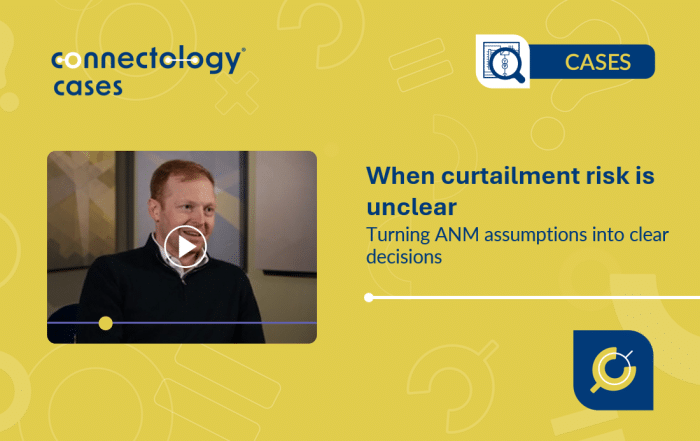
Turning ANM assumptions into clear decisions
If we are a fit, you can let us handle your grid risks and complexities, so you can focus on achieving real impact.
Summary:
Welcome to another Connectology Case, through which we explore specific obstacles the Connectologists® have faced when guiding champion clients to their grid goals. In this episode, Connectologist® Philip Bale details how a battery storage developer discovered their project carried far greater curtailment risk than the connection offer suggested.
The problem? The offer hadn’t made the risks clear, and the client was working to a tight timescale. Philip explains how a rigorous, scenario-based curtailment analysis — modelling how often the DNO could restrict the battery’s ability to import from the network, potentially to zero — transformed the client’s understanding of project viability. He details the critical lessons about ANM schemes, the limits of curtailment reports, and why probabilistic scenario modelling is essential before serious capital is committed.
Transcript:
00:05 – The project
So, this was a really important project for us to assess. It looked around all of the risk around active network management, curtailment risk curtailment analysis, understanding for a project that had import constraints, how much risk there would be battery storage, how often the battery wouldn’t be able to import. It was a particularly challenging one because it was a new active network management zone, it had a seller who thought their project was amazing and a buyer who really wanted to understand what the risks were.
So, for this project we had to really go into how the network would operate, how the active network management scheme would run, and ultimately try and understand the risk, articulating that to the buyer and also to the seller as well. So, at the end everyone had a very good understanding around how the scheme would operate and what would be the risk.
00:56 – The importance
This case study is really key for anyone who has a scheme with active network management because ultimately curtailment reports are only as good as the assumptions that they’re based on. So understanding what the assumptions are, what the base data is, understanding how things can change, understanding how it could impact your scheme positive and negatively — to ultimately tell you if you have a good project or if you don’t, what you should do to better understand how much risk you have and therefore when you should start investing the serious money into a scheme.
Curtailment risk should be considered for any scheme with active network management. Active network management is where the DNO has the capability of reducing the import or export down potentially to zero under normal network running or under abnormal network running. Curtailment risk is understanding how often, what are the chances, what are the scenarios where your scheme will be restricted from either importing energy from the network for battery storage or potentially exporting from the battery into the network.
01:58 – The challenge
In this instance there was a scenario where the DNO could reduce the import at certain times where the battery would be unable to charge from the network. And it was really important to understand the curtailment risk of how could this battery storage be charged, when could it import from the network? Was there a scenario where a battery wouldn’t be able to import power during the low demand periods to allow it to export at the periods when the battery would normally operate?
So, we needed to create a fingerprint for the risk for this specific network so we could understand what are the different scenarios where this battery could have been prevented from importing, how that changes under different assumptions — so that ultimately whoever was going to invest into this project would understand how they could operate this battery storage in an economic model.
02:46 – The method
The method for this curtailment assessment was spreadsheet based. We had a year’s worth of data for this specific model. We had various different assumptions and models which we layered on in numerous different scenarios, so we could then identify where there would be curtailment, when it would occur. Also looking at a probabilistic event of normal and abnormal network running to ultimately build in a number for the developer for different scenarios that they could build into their models.
03:13 – The solution
So, in this instance for this study, the client left with a really clear understanding that was very different. When they first came to us with the project, initially they thought they had a project which was incredibly low risk and they ended up leaving with a project understanding there was some fairly significant risk that would occur under different scenarios. And ultimately, they then had a much clearer understanding as to if this project was viable and what would happen if the following scenarios came true.
So, this analysis was done around about a year ago on a demand ANM scheme, which was still relatively new for most of the DNOs across the country. Demand ANM has followed generation ANM and has significantly different challenges.
Ultimately, each of the DNOs are trying to find out how they should operate these ANM systems in order to unlock capacity for customers but also keep their network safe and efficient and not cause unwanted problems. Very technical, very key areas.
One of the challenges was that the offer was written in a way that didn’t make a lot of the risks particularly clear. The customer was looking at completing on the scheme in a very tight timescale. So therefore, we had to work with them, some of the times with the information being drip fed through to us so we could build up our confidence, build up the understanding, work with the network operator, the buyer and the seller to improve the picture and then provide the answer to the customer so they had a better understanding.
04:42 – Collaboration
So this was a scenario where actually we had a fantastic client. They came to us, they were really interested in what we had to say. We would deliver our report, they would take it in. It was a very complicated technical area that they picked up incredibly well. We also worked really quite closely with the seller. They had very specific views around the curtailment risk and one of the aspects was for us to engage with them and for them to really also understand the curtailment risk for their project, which was quite different after we did the analysis from where they started.
05:15 – Key lesson
The main lesson that’s learnt for this is that whenever you are looking at a network that has active network management, it is critical to understand the risk for any project. In order to understand the risks, you need to understand how the ANM scheme will be designed and operated, the risks that that could change over time, the different scenarios that could happen, which influences the risk — so you can build up not just one number, but multiple different scenarios and then work out what is the different likelihood of risks under the different scenarios.
So I think you can make really good decisions with schemes with active network management by first understanding the network, then understanding the ANM scheme that will be installed and how that restricts the network and then understanding the various different credible scenarios which can restrict the output of the project and if they will happen and what different probabilities of them occurring.
Watch more of our latest Connectology® Cases
Zoe Hancox2026-06-08T13:56:12+00:00
Zoe Hancox2026-05-19T07:58:00+00:00

Zoe Hancox2026-04-01T11:58:24+00:00