If time-to-power is your biggest risk,
what is the biggest risk to your time-to-power?
Summary:
A project’s time-to-power depends on decisions made at almost every stage, not just the connection application. Understanding where those decisions sit, and which ones remain open to influence, can be the difference between a connection that arrives on schedule and one that quietly slips for months or years.
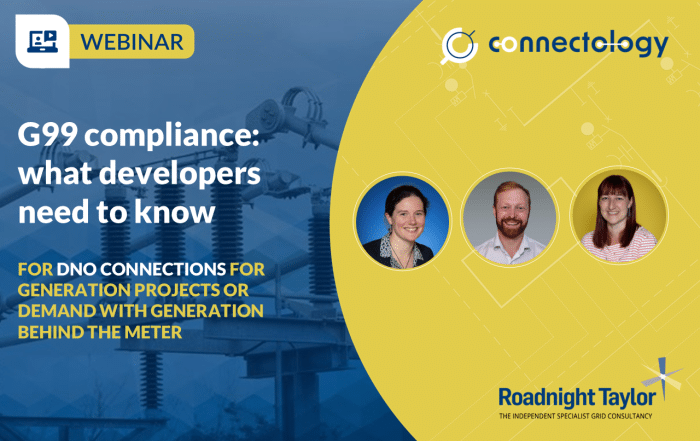
In this Connectology® webinar, hosted by Hugh Taylor, Connectologists® Pete Aston, Rachael Eynon and Kyle Murchie worked through the project life cycle from origination to energisation, exploring:
• how oversized applications can return offers with more than 50 enabling works, each a potential source of delay
• why sizing and transmission impact decisions made during feasibility can shape timelines years later
• what may still be negotiable once an offer arrives, and even after it has been signed
• questions worth putting to network operators about critical paths, cost increases and outage conflicts
• why outages, compliance and late studies can turn small slips into delays of six months or more
The discussion is relevant to generation, storage, demand and data centre projects at any stage, from early feasibility through to commissioning.
Transcript:
00:00:00 – 00:00:06 – Hugh Taylor
Hi, it looks like Zoe has started the webinar. We’re going to kick off at 10 o’clock sharp, and I like to fill the dead air. So, Rachael Eynon, hi.
00:00:14 – 00:00:15 – Rachael Eynon
Hello.
00:00:15 – 00:00:33 – Hugh Taylor
So, you’re our most recent joiner, and I saw you speaking at a NESO gig up in Edinburgh, which was very exciting. So, what do you like most about the Connectology® webinars? What did you like most about them before you landed here?
00:00:34 – 00:00:57 – Rachael Eynon
I think just the opportunity for, like, a bit of open, kind of frank discussion, and, like, exploring real examples that we’re seeing. So, you know, a lot of time in the NESO network company webinars, it’s always kind of kept broad, and we can’t go into those project specifics, but bringing some of those anonymized examples is good.
00:00:57 – 00:02:10 – Hugh Taylor
Great, and so we’re looking for open, frank discussion, people. It’s clicked over to 10 o’clock, so we’re going to start we always start at, exactly, sharp, because there are a lot of people on here. We had 300 and something, 350, a bit more than that. So, it’s our second biggest webinar to date, and I’m very excited to be coming out of retirement, well, webinar retirement, to host this one, because it has been, the phrase time-to-power I’m hearing so much from clients and prospective clients, and it’s gone from being a thing to being the thing. So that’s why I actually said, I’d really like us to do this webinar. And I wanted to host it.
So, I’m going to very quickly, I don’t introduce the team and their credentials, because, we’ve got so many frequent flyers, you’ve all know who they are, anyway. So, Zoe is just going to put links to the bios for each of these three, Pete Aston, Rachael Eynon, Kyle Murchie, into the chat, so if you’re interested, you can have a look at that. But very, very quickly, so Pete, why have we got Rachael on here?
00:02:11 – 00:02:21 – Pete Aston
Because Rachael’s experience from the NESO side is really, really helpful in trying to sort of tease out some of these time-to-power issues.
00:02:22 – 00:02:25 – Hugh Taylor
Thank you very much. Rachael, why Kyle?
00:02:26 – 00:02:41 – Rachael Eynon
Kyle’s got experience from the DNO side, the developer side, and then since has brought that all into the Roadnight Taylor side, so has a well-rounded perspective, and lots of recent experience in that late-stage commissioning process.
00:02:41 – 00:02:45 – Hugh Taylor
Wicked, thank you. Kyle, why Pete?
00:02:46 – 00:03:04 – Kyle Murchie
So, Pete’s got a wealth of experience, particularly from, I guess, starting off in the networks, and more recently, obviously, a lot of the significant work that he’s been doing on projects of all scales. So, I think he brings a really unique perspective as well to the three of us in this session.
00:03:05 – 00:06:17 – Hugh Taylor
Cool. And I think I think I might have handpicked you from the seven. And the reason that I’m here, I’m Hugh Taylor, I’m CEO, I’m only nominally in charge here at Roadnight Taylor. And importantly, I’m a complete lay person as far as grid is concerned. So, I’m representing all the lay people in the room there in the audience, which there will be many, many, there’ll be loads who are like massively technical, but many who aren’t, and so I’m going to occasionally ask the odd question that if it sounds like a bit what I’m talking about when it comes to grid, then that’d be absolutely, absolutely right.
Another reason I’m here is, you know, this is 3 of the 7 Connectologists® is a huge number of the connectologists® all in one place at one time. We need to get as much kind of value from that as we possibly can, and hundreds of people who are very busy, very important people who are actually taking the time to be on and watch the webinar, the webinar is recording as well.
So, I’m going to make sure that this is really fast paced. And so just occasionally, you might have me say speed up. So the format is we always do is just kind of eight questions. They just kind of chew the fat on the connectologists® do, but it’s completely interactive. So please, please, please put your questions into the Q&A. Hopefully, you can all find the Q&A. Really importantly, we can’t get round, we can never get round to all the questions. There are always so many questions. So please, please upvote the questions you would most like answered, okay? And then we’ll deal with them. And we deal with them as we go through it. So, it’s quite sort of free and flexible.
So, yeah, I think that’s about the size of it. So, a fast game’s a good game, and I don’t know who we’re going to first. But if we could have Zoe in the background. Hi, Zoe. If you could give us the first slide, and then somebody is going to jump in and answer it.
So, what is that? Oh, that’s me! So, time to power, that’s me, I think everybody knows the answer to this. I mean, you know, we don’t even need it. It’s basically, I guess it’s how long it takes to get connected, but I think the main thing here is are kind of against your expectation. So, a delay in a time-to-power is the delay to whatever, whoever is the investor, or whoever it might be, is expecting, you know, what’s in the spreadsheet, I guess. So, it’s time-to-power is how long it takes to get connected.
Thanks, next slide. Okay, who is taking this one? So, this is divided into two, so you can see on the right-hand side there that we, this is the way we divide the project life cycle. It starts in early development, kind of origination, and goes all the way through to, to operation. I guess decommissioning’s at, at the very, very end of that. That’s the way that we look at things. And then we’ve got, within that first phase, we’ve got two, examples of where things can go wrong in terms of time-to-power. So, who’s taking that first one, developing the ask?
00:06:17 – 00:08:37 – Rachael Eynon
That’s over to me. So yeah, this is thinking about, those kinds of pre-offer decisions, to figure out exactly what you’re going to put, sorry, pre-application decisions, to figure out exactly what you’re going to put in there. So recently, I’ve been working with some clients, and we’ve been kind of looking at their pre-Connection Reform offers and kind of what could have been done differently there, where they’ve potentially kind of put in the blue-sky thinking, what’s the sort of maximum they could get, and waited to see what’s come back from that. And as those who’ve been through this process many times will know, that often results in the kind of absolute worst-case scenario in terms of what comes back in the offer.
So, in these cases, we’ve seen, like, oversizing of projects, so considering, kind of almost a portfolio, but within one connection, so kind of multiple gigawatt connection applications going in. And these have come back with, you know, over 50, enabling works in there, so, non-attributable enabling works in most cases, so it’s not necessarily that you’re funding them, but that’s 50 different projects, or, like, network operator pieces of work, that could individually, lead to delays on your project and all have a delivery date associated with them. So, essentially, the more of those you’ve got on your offer, the more risk there is that one or more of those is delayed, and you see those pushbacks over time.
So, applying for all that capacity in one go would have really, kind of, concerned the network companies, when they’re such large connections. So, this is where thinking about, how you can split that up or stage a connection can be really helpful. So, thinking about whether there’s natural step creases in capacity that you might be able to deliver independently, or whether you’ve got different technologies within that connection, and can these be delivered at different times? And in some cases, you might be able to have those discussions up front before the offer, with the TOs and the network companies, to try and understand what might be possible. In other cases, it might be a kind of strategizing on, what alternative approaches you could take if the offer comes back and doesn’t look the way you want it.
00:08:39 – 00:08:58 – Hugh Taylor
Cool, I just, caught Kyle typing answers to questions, and essentially, if a question’s worth answering, we’re going to answer it live, which is really important for all the people who are watching who aren’t live now as well. So, Pete, Kyle, anything to add or challenge? Love a bit of disagreement.
00:09:01 – 00:09:02 – Pete Aston
No, I don’t think.
00:09:02 – 00:09:08 – Hugh Taylor
Kyle doesn’t because he was too busy typing an answer to a question. Sorry, Pete.
00:09:09 – 00:10:07 – Pete Aston
So, I think, yeah, just on that specificity and modularity, yeah, it’s really important to just you know, work out what it is you really want, upfront. And I was just thinking, as Rachel was, speaking, actually, that, a lot of this, because we’re obviously talking about the sort of, you know, upfront feasibility, origination phase here, that you sort of just have to assume that there will be a time-to-power risk at some point in the future of your project. So, what can you do now to try and back that off as much as possible, which is a difficult ask, because you are sort of trying to look, you know, 5, 10 years, potentially sometimes into the future, but it’s having that mindset right from the beginning to go, how can I best back off that time-to-power risk from even what, you know, what I asked for, what I applied for, and that’s really important to work that through right from the very beginning.
00:10:09 – 00:10:49 – Kyle Murchie
Yeah, the only thing I would add very quickly was just particularly around demand, because I think a lot of listeners that are very much in the generation space, you know, have a lot of experience in putting applications in, but also working out what that needs to look like, you know, what are they really asking for? Whereas, if your day job is very much not in the energy industry, that can be quite difficult to try and work out, well, what do we really want? You know, there’s so many different variables on your side that you know, it’s very easy to say, well, we’ll focus on those, and we’ll try and create quite a kind of wide grid concept and application, but actually, that’s going to come back and bite later, so doing more work up front is definitely advised.
00:10:51 – 00:10:58 – Hugh Taylor
Cool, thank you. Right, are we ready to move on to the second one? Concept. Who’s that?
00:10:58 – 00:13:16 – Pete Aston
Yeah, that’s me. So that’s really sort of just picking up on this theme of what do you do in the origination phase, the feasibility phase. And it’s really important, perhaps the most important thing is thinking around the transmission impact risk of your project. So, one of, one of the things, I guess the key thing is, how can I avoid transmission impact, to start with? So, if you’re a generator, that’s relatively understood, because there’s very clear limits in England and Wales and Scotland as to, over which, you’re going to have to do a transmission impact assessment, say 5 megawatts England and Wales, 200 kilowatts, is it, Kyle, in Scotland?
So that’s really clear-cut. So, one of the things is, if you want to develop a 6-megawatt solar project, you probably want to develop a 4.9-megawatt export solar project, because, you know, the difference isn’t very great, but you’re going to avoid that massive transmission impact risk. So, but if you want to develop a 50-megawatt solar project, probably reducing to 5 isn’t then going to help, so you might just need to carry on understanding that you are going to have that transmission risk.
On the demand side, it’s actually much less clear because there is no defined limit across, anywhere, and in fact, I think even the limit even sort of changes within DNOs sometimes. So, some DNOs sort of have a fixed limit, like some DNOs have, like, a 5-megawatt limit. Other DNOs for demand sort of will try and just squeeze in as much as possible, as much as they think they can fit in without causing a transmission impact. So, it’s quite hit and miss across the country. I think there is probably some work going on at industry level to try and talk around this and see if that needs, clarifying, and sort of some consistency. But that sort of thing is really important with demand projects to try and go, am I going to have a transmission impact or not? This is for distribution demand projects at this early stage. So yeah, I think that’s the key things to sort of flag up at this point.
00:13:19 – 00:13:20 – Hugh Taylor
Kyle, Rachel?
00:13:21 – 00:14:08 – Kyle Murchie
Yeah, so on transmission impact, I suppose, going forward, the big issue isn’t just once you’ve got your offer, then triggering a transmission impact assessment. It’s then you’ve got to fit into the next gated window. Certainly, for generation and storage, if you’re demand, you can go through your Mod App is open at any point, so the DNO could submit that. There’s also some practicalities around when the TO can potentially do those assessments, but certainly for a generator, you’ve got to factor that in now as well, which wasn’t something that we’d necessarily been considered before. And I suppose the impact on time-to-power is that, well, that could easily add 3, 6 months onto the kind of early stage of the project, so already you’re starting to accrue lost time that needs to be factored in early.
00:14:10 – 00:14:58 – Rachael Eynon
Yeah, I think it’s the being conscious of the delays that can create in the application process and the offer process, because you’re essentially adding another party into that chain, to pass back information, and also more for you to kind of understand and review at your end. But the kind of 5-year wait to 10-year wait that we’ve referenced on there is just to represent some of the things that we see coming back in those offers. So, while the picture might look quite good on a distribution level, the kind of local network can handle your connection. Once that’s gone up to transmission, and they’ve considered that in the round with all the other projects that have triggered that assessment, that’s when we start seeing things like brand new grid supply points being needed, or new transformers, and that’s where we get those much longer delays coming back in offers.
00:14:59 – 00:16:20 – Pete Aston
Hugh, there’s quite an interesting question that’s come in that I think relates to this quite nicely from Peter Woodcock. Where is the incentive to define your project capacity well during the design stage and connection application, because reducing capacities, like non-gated, but increasing capacities gated? So yeah, I guess the sort of thrust to this question is, why can’t I just go in really big at the beginning and just reduce capacity at some point in the future?
There is some truth in that, and we would always advise customers going slightly bigger than they might need. Because you can reduce capacity through the process. I guess the incentive to, to not go too big are things like, triggering reinforcements that you might, otherwise not trigger if you go a bit lower. Because, like, even if you’re not paying for reinforcements, you might still have to wait for them. Then there’s things like the data centre Commitment Fee that’s coming in. If you’re thinking of developing a data centre, obviously the fee isn’t directly proportional to the size of your project, so there are quite a lot of things that you that you would want to go actually, if I go too big, I’m going to potentially impact my time-to-power because of reinforcement works. Or I might just, have, you know, higher securities or commitment fees and that sort of thing.
00:16:21 – 00:16:21 – Hugh Taylor
Cool.
00:16:21 – 00:17:26 – Kyle Murchie
There’s another one from Oliver that I think we could probably answer in this round as well. So that is, can you give more indication on which DNOs have the largest demand limits for TEAs and what they are? How large can they be?
I mean, certainly, I suppose from a demand perspective, traditionally, it’s been probably a little bit easier from the DNO perspective, because there is always really clear limits at each of the GSPs, and that’s obviously not been growing as quickly as we saw with generation and storage. Storage obviously started to mix that up a little bit with the demand aspect of storage. But certainly, you know, 10 megawatts, I’ve definitely seen that, even in a Scottish DNO, where that was acceptable and not triggering a transmission impact assessment, but it can vary, and normally the DNOs will be the best people to kind of ask. Some of the tools that are available now give a bit of an indication, but around the threshold, then it’s either getting some specialist advice or speaking to the DNO directly. I don’t know if you had any other thoughts on that, Pete?
00:17:26 – 00:18:12 – Pete Aston
Yeah, I was just going to say, historically, I would have said anything that was 50 megawatts and above would always have been, sort of, assessed up for a transmission assessment you know, irrespective almost of knowing what transmission issues there were on the network, I think that sort of level of capacity would have been seen to have had a material impact on the transmission system. You’d probably be lucky to get 50 megawatts now in anywhere, I would imagine. There may be a few places, I guess, but yeah, I think most of the DNOs are probably, even those that were maybe a bit sort of freer with the capacity, that may be starting to have to reduce that down a bit just because of the size of the demand queues. Sorry, and I think, Rachel, you were going to?
00:18:11 – 00:18:23 – Rachael Eynon
It was a similar point. I think we’re just, we’re seeing the DNOs kind of diverge towards that, converge even, towards that 5-megawatt number, while it’s not kind of official anywhere. That’s the, the kind of known limit in some cases, but in other cases, it’s not that there’s a sort of known higher limit, it’s more that there’s room for discussion, and it becomes more project and GSP-specific.
00:18:39 – 00:21:10 – Hugh Taylor
Good, right. I’m conscious of the fact that we’ve got, eight of these to get through, we’re two through, and in the past, we’ve made some of these webinars been an hour and a half, but this one’s definitely only an hour. So, if we could, just, Zoe’s going to launch the poll, so Zoe, if you could flash that up now.
And these are, we’ve got two stunning questions, written by me, so apologies if they don’t make any sense. So, based on your consideration of delays in time-to-power. where are the stakes highest? Is it pre-offer, offer, design, or delivery? Where are the stakes higher?
And the way that we’ve kind of organized this webinar is the further through we go, the closer we get to energisation and therefore, kind of my understanding is that states get higher as you get closer, but who knows? So, we’ll find out in that when you do that poll.
And then question two for projects that have reached final investment decision – FID. What delay to energisation versus the data assumed at FID would you typically expect? So, this is the length of the delay that you typically expect paste FID. So, is it less than 3 months, 3-6 months, 6-12 months, or greater than 12 months? And so I was, talking to a client the other day, and he said, the only thing we can guarantee in our projects is that there will be delays. And which I thought was, interesting, and suboptimal. But that is just, you know, where we are, and it’s why we’re having this webinar. And he said that they expect a minimum of six months in theirs, which was, you know, quite an eye opener for me, you know, and he said 12, 18 is normal. And obviously, it’s expensive, so they want to reduce that. So, it’d be really interesting to see what you would expect to have across your portfolios. What would you expect to have?
So that’s the poll, answer those. And then before the end, we will do the big reveal. So, thank you for that.
Zoe, could you possibly jump onto the next slide and then we’ll try and gallop through, through this. So, here we are, grid offer. So, we’re at the new stage. You can see a little diagram on the right. We’re now on the design stage. So, the query offered solution, the design is not always optimal for various reasons. So, who is taking this?
00:21:11 – 00:23:46 – Pete Aston
I am, so yeah, there’s definitely lots of situations whereby you’ll get an offer and it’s not quite what you’ve expected, and I think some sometimes there’s a sort of a point where you go, oh, okay, well, that’s a shame, I’ll just have to live with this. But actually, there’s quite a lot you can do with the DNOs and essentially TOs, in terms of, sort of, post offer issue conversations, or even conversations to happen whilst offers are being prepared.
So, there can be opportunities, sort of to come to DNOs with suggestions to go, we know we’re going to be connecting, sort of, around here somewhere, have you thought about this, that, or the other. Because it might be that, you know, DNOs very busy, and they’ve only got sort of a, you know, a limited scope of what they’ve seen. Because they only look at their own networks, and they won’t necessarily have seen what’s going on on other networks.
So, there is the opportunity to go, well, you know, have you thought about doing this, or that, or the other? Sometimes DNO policies that they have don’t allow different, sort of, sort of configurations or whatever, but there’s no harm in trying to suggest different options and talking with DNOs as to why they can’t be done. I’ve definitely done it before with offer, with an offer to go, here’s a drawing of a couple of options that I’ve thought about as to how this could be done.
But I think it’s just, you know, doing it respectfully, because obviously the DNOs have got the task of designing the network and running with it for operating it for 40 years, so they’ve got to be comfortable with whatever they do. But yeah, I think there’s lots of opportunities there to go, well, why have you put it here? Can you not you know, why are you connecting me to this tower when there’s a substation 100 meters away, and I could connect via busbar into that substation? So that was one particular example I had a few years ago and got into discussions with the DNO about whether it could be done or not. And some of the reasons why they go they might not be able to do it is sort of just that maybe they’d yeah, we’ve never done that before, you know, and you often come across that to go well, here’s an opportunity to do it for the 1st time. So yeah, I think there are lots of opportunities for coming up with different solutions.
00:23:47 – 00:24:20 – Hugh Taylor
I remember that busbar connection example, Pete, because I weirdly was involved in that and it was amazing to see that you could actually convert a completely suboptimal unviable connection into an overhead line, into a busbar connection just on the basis of a conversation with a system planner who, probably was uncomfortable with that connection arrangement, but took it on nonetheless, which was, which is really cool. Okay, any on that, or are we moving on?
00:24:21 – 00:24:24 – Kyle Murchie
Nope, I think I happy to move on, if that’s all right.
00:24:24 – 00:24:25 – Hugh Taylor
Who’s that?
00:24:25 – 00:27:31 – Kyle Murchie
So that’s me. So, this is kind of post offer signing. Just noting that, yeah, even if you get to a point where you have to sign the offer, you’ve got it to a position where it’s maybe, as Pete said, is certainly significantly better, it’s a solution that is workable it doesn’t necessarily mean that that’s it, it ends there; there are obviously opportunities to improve on that position. Now, that could be through a kind of longer-term strategy and thinking about a Mod App in the future, if it was a transmission connection, and thinking about how, what that might look like, but doing that pretty much as soon as you’ve accepted the offer. I know one of the questions we’ve got is actually around the next window, so I was thinking about that, the kind of CMP434 window, that would apply to new applications, but also to Mod Apps as well. And the question is around whether that would be a biannual window for the full process for applications and then lasting for kind of 12 months for each window. I think the answer is we don’t really know yet. There’s lots of kind of discussions that have been going on at industry level and have gone back and forth with different views. If we go back to the Code Mod, the Code Mod was designed to have two windows per year, and those kind of running almost for 9 months, with a little bit of crossover. But you know, so for those 9 months is from application opening to all the offers being issued. But in reality, it could be more flexible. All the Code Mod says is that once started, the process, once the process gets started, it has to be once annually. So, there is quite a bit of scope there for that to develop over the next couple of months.
But in terms of looking at other options, so there are lots of little initiatives, which quite often are very small in isolation, don’t apply to all projects, but once you pull a few of those together, quite a bit of work can sometimes need to be done to do that. We’ve seen quite a few examples where you’ve been able to go back and have a conversation with the DNO, work out whether there are projects that maybe started to fall behind or stalled, maybe not going to use all their capacity that’s been allocated to them, or certainly not all the capacity in the first couple of years, having a more pragmatic conversation about, well, when is that power actually needed, and can we do something different, keep the same queue position, but facilitate access earlier similar transmission world, it’s just called a timed CPA. Not necessarily an easy approach and process to go through, but again, something that has been achieved in some cases where the planning, basically, I assume it takes into account the stage of these projects. So, if a power station isn’t going to be built, or is unlikely to be delivered in 2028 as initially intended in the queue, then can some of that capacity be moved around a little bit to help facilitate access to the access to the system?
00:27:31 – 00:27:39 – Hugh Taylor
Okay, and I’m really going to show my lay credentials here. What is a CPA, a timed CPA? What’s one of those?
00:27:39 – 00:28:55 – Kyle Murchie
So, it’s the construction planning assumptions. So, it’s the kind of base data that’s given to and base set of assumptions that comes out in a data form, and that’s handed over from NESO to the TOs, so he transmission owners, and when they do their assessments, they do all the system planning on the basis of that kind of baseline data.
So, if a time so a timed CPA takes into account the time of when connections will be made. So, at the moment, all the CPAs have been based upon, well the kind of baseline is that everything is based on queue position, so a Gate 2 to the whole queue happens, everyone gets a new queue position, and that position is then used to upon which the, the system modelling is done.
But a time CPA applies that time factor on there as well, and thinking about, well, when is the project realistically going to be able to come online, or is there a stage in there that’s currently working through the process that isn’t contractually there yet that we can start to factor in?
It’s to try and prevent us getting to a situation where there’s a queue of, you know, a gigawatt connecting in a particular area, but actually those 3 or 4 years where there’s 500 megawatts sitting there available that somebody could have got access to earlier.
00:28:56 – 00:28:58 – Hugh Taylor
Sounds like a good idea.
00:28:58 – 00:29:09 – Pete Aston
There are Hugh a few questions that have come in that I think sort of relate to offer and post-offer stage, and one of them I was going to give to Rachael, even though I’m not the host.
00:29:09 – 00:29:11 – Rachael Eynon
I think I know which one this is.
00:29:11 – 00:29:16 – Pete Aston
The top one Rachael about NESO, NGET and Gate 2 process delays and.
00:29:16 – 00:30:32 – Rachael Eynon
Yeah, I was going to jump in off the back of Kyle’s. I think there’s both angles to this. There’s things coming out in offers that you’re not expecting, so it’s, trying to have that negotiation in the offer stage, before you’re signing that offer. So, you’ve got, at transmission level, kind of 4 weeks to raise those queries, but where you have immediate concerns around dates try and get those in as soon as possible because changes to those will then change everything else.
And we can say that we’ve seen more willingness to kind of negotiate on dates where there is delays, from a customer perspective, so I think that then comes on to the Q&A, where you’ve had delays that arise from the uncertainty of Connections Reform, we have seen the TOs more willing to look at shifting that date slightly, potentially more kind of a within-year shift than multi-year shift. But that is the time to try and look at that before the offer is signed and sort of more finalised. So yeah, raising those queries early through the portal and through CCMs, if you are getting those assigned now as well for portfolios, and yeah, just trying to keep on that engagement.
00:30:33 – 00:30:41 – Pete Aston
Wasn’t there some, wasn’t NESO looking to do, essentially, a round of Mod Apps for customers who want to delay projects?
00:30:41 – 00:31:27 – Rachael Eynon
Okay. Yes, so we had the, CMP, I’m going to mix them up now, I think it’s 471 is the one for, a kind of time-limited, delay change request. So that is kind of going through the process, and we have responded to the consultation on that. I think it’s unclear where that’s going to land at the moment one route could be that gets implemented, and there is a short opportunity now to, request those delays. The alternative could be that if, NESO and the network companies are closer to being ready to open the next window, they might just skip that and try and do it all in one kind of more formal window. So, need to see where the decision lands on that one.
00:31:28 – 00:31:30 – Hugh Taylor
Can I just ask what a CCM is?
00:31:31 – 00:31:41 – Rachael Eynon
A Connections Contract Manager. So, there would normally, there’ll be teams at NESO, generation teams, demand teams from Scotland and England and Wales, and those teams are your, kind of, points of contact to support with your offer discussions and general discussions about your connections, so that’s your, kind of person link that sits alongside the portal query route as well.
00:31:56 – 00:31:58 – Hugh Taylor
And how well does that work?
00:31:59 – 00:32:00 – Kyle Murchie
Well, not at all at the moment, does it?
00:32:00 – 00:32:12 – Rachael Eynon
Yeah, so, CCMs were kind of, I guess, closed off to access during Connections Reform, to give them time to establish a sort of query answering process. I think everyone’s aware that that didn’t kind of work as well as they’d hoped, so now NESO have confirmed that they’re bringing CCMs back, so people should start to see them, or yeah, be able to put some faces to names soon.
00:32:27 – 00:32:28 – Hugh Taylor
Hurrah!
Pete.
00:32:30 – 00:32:37 – Pete Aston
Yeah, there’s some there’s some really interesting questions, so I’m getting just tell me off if I’m getting diverted Hugh with answering too many questions.
00:32:37 – 00:32:37 – Hugh Taylor
No, I think we’re good for time actually.
00:32:37 – 00:34:12 – Pete Aston
Okay, fantastic. So, there’s one from David Somerset around, sort of Ofgem strategic demand, Curate consultation, which is really around new milestones being proposed for data centres, and data centre commitment fees.
So, so are you seeing the new demand milestone 0.5 as a major push factor for really getting under the bonnet of defining a site much earlier? Well, I guess we’re not really seeing anything actually happening yet, because it’s sort of, I guess, just a proposed milestone at present, but the milestone 0.5 was, correct me if I’m wrong, Rachael or Kyle, to, have a non-binding offtaker agreement, so i.e. you need to, to, evidence the fact that you’ve got someone to take the computing power from your data centre, and that’s within was it 6 months of accepting your offer, so it’s really early, probably much earlier than most data centres would typically have an offtaker available.
So yeah, I don’t quite know what’s going to come out the back of that consultation. So, we’ll see what Ofgem say on that, but yeah, if it did come in, it would really mean that, developers have to you know, get under the bonnet, as it were, of that site much earlier on in the process. And obviously, if you miss that, and then you get kicked out of the queue, you then have to pay the data centre commitment fee that you’ve already signed up to by accepting your offer. So, yeah that could be massive changes coming through from that.
00:34:12 – 00:34:25 – Hugh Taylor
Thanks, Pete. We’ve got two questions here that have got three have been upvoted three times, you know, which is a bit of upvoting. We’ve had, like, nine or ten in the past but anyway, so have they been, have they been dealt with?
00:34:25 – 00:34:43 – Kyle Murchie
No, but I think the first one I might ask Rachael, because, the first one is, how long will TIA take in the new world? So, a Transmission Impact Assessment would normally take 3 months once started. But Morgan was going to noting that the thinking is now going to be 6 months, is that we are our thinking’s at?
00:34:44 – 00:35:24 – Rachael Eynon
Yeah, I think difficult to say, and how that’s going to look for transmission, sorry, demand versus generation is another question, but, yeah, I think this is likely to extend, or, where it needs to tie up with the gated process, If we do end up in a world where there’s less than two windows yeah, one window per year, or, they’re kind of over, sort of 6-month frequency. So yeah, that could be pushed out, but I don’t think we’ve seen anything to kind of formally confirm what that’s going to look like.
00:35:23 – 00:37:03 – Kyle Murchie
And I was going to take the other from John. So, are you aware of any project with a BCA with NESO that has not been delayed by NESO or NGET post FID during construction? Which I think is a very good question, and I kind of completely emphasized because, you know, we see projects day in, day out, which are exactly in that sort of situation. There are I mean, certainly from a personal perspective, yes, I have seen some projects that have pretty much worked to time, and that the delay has been you know, we’re talking kind of a small number of months. I suppose it’s that expectation that projects will always change from a timeline perspective, you know even if a project’s working really, really well to a date, you know, most projects have either an April 1st or end of October, connection date at transmission level. Clearly, that’s not going to work once you get much closer to the timeline, in a lot of cases, and therefore dates do move a little bit.
But the significant changes that we’re seeing at the moment, and certainly things that we’re seeing coming through offers, where obviously reinforcement is behind, because the level of network investment is obviously so much more significant now than it would have been, you know, even go back 5 years ago, then yes, it’s definitely a greater risk, and also seeing it quite late on. So, yeah, if anything, and there are lots of conversations about how can that be mitigated, you know, how can that the site of that delay be seen much, much earlier in the process, which is partly hopefully one of the benefits that will come out of Connections Reform, and some of the changes in the SSEP and RESPs over the next couple of years.
00:37:04 – 00:37:17 – Hugh Taylor
Good. I think we better move on to the next slide. So, we’ve got four through and we’ve got four to go. So, two on this slide design early delivery. You can see we’ve moved around to the pink little sector at the bottom and so who, who is this example one?
00:37:22 – 00:40:18 – Kyle Murchie
I’m example one and, yeah, basically, early engagement, I think we talk about this at design stage, talk about it at the commissioning stage, kind of bat the same drum around early engagement on any changes. You know, as soon as issues start coming up, and your project starts seeing those issues, or maybe needs for change, there is absolutely a point at which that should be communicated, if, you know, there is a bit of thinking that needs to be done around what from a strategy point of view also, you don’t necessarily want to be making Mod Apps continuously as little things crop up. So, you know, it is really important to log that and then understand what the impact of the change is, and effectively manage it as part of, effectively, our risk process quite early on. But don’t leave, you know, we do quite often see where those design kind of questions get left for quite some time, and it’s going to pass from initial design into detailed design and feed, and maybe not kind of fully resolved.
And, you know, the example that we had here specifically was, we’re kind of covering quite a lot of bases, but particularly when cable routes change. So maybe going, you know, as you’re going through planning and getting, kind of, clarity on the route, or you’re actually in tele-delivery now, and you’re starting to you know, actually get evidence on the ground, you know, trial holes are being done, identifying that actually that route isn’t quite possible, and we need to go back and almost go back to the drawing board a little bit and change the route that also has quite a big impact on a project, because you can go from in the delivery, you know, almost starting the delivery phase, through to pausing and having to go back round and do a design loop again, which can add months onto a project. There’s one we’re working on at the moment, which has effectively added a full year onto the project getting corrected.
So, significant impact, but you don’t know you know, you’re not finding this out until after FID. So, you’ve already got FID, spades are actually in the ground, and you’re discovering this quite late on. So, some lessons learned would be particularly around able route, and kind of so either late design changes or late changes that come in based on planning. So, if there’s any kind of planning conditions, getting those closed off, or kind of identifying which ones might impact the actual route and the delivery ability of the route, council engagement in that case, and also making sure that, you know, you’re very clear, you’ve done the trial holes, and you’ve gone a bit over and above the standard route proving, where there’s maybe a high expectation of risk in certain areas tends to be, if you’ve got a route where there’s no cable installed, that’s probably a higher risk route because you don’t really know what the ground conditions are until you’ve started to do the trial holes.
00:40:16 – 00:40:18 – Hugh Taylor
Pete, Rachel, anything to add?
00:40:19 – 00:41:11 – Pete Aston
Yeah, I mean cable routes are just, you know I’ve been, I was a System Planner for many years, and it was really easy for me to draw a line on a map to go, connect from here to there, and then a delivery colleague would go, are you kidding? There’s no way we can do that for some reason or other.
So yeah, it’s really important to get out and get those sort of early, early cable route designs going as quickly as possible, because there’s all sorts of things, not just sort of, you know, risk of some horrible substances in the ground that you don’t know until you start doing trial holes, but, you know, bridges, rivers, railways, I mean, working with network rail takes forever, so that, you know, that’s got to be done really early, because even if you know it’s a risk, it’s still going to take you longer than you think to deal with it. So, yeah, fully agree with what Kyle was saying.
00:41:12 – 00:41:13 – Hugh Taylor
Yeah.
00:41:13 – 00:41:29 – Rachael Eynon
And I think the engagement; it’s not waiting until that risk has become an issue to raise it. Even if you’re not sure how you’ll be managing that, raising that early can kind of put more options on the table and keep them open for a bit longer before you get kind of too far down the line and then probably brings me into my outage example of the other kind of knock-on impacts that can have.
00:41:34 – 00:41:41 – Hugh Taylor
Yes, I did wonder whether you were going to be the outage example, Rachael. What does Rachael Eynon know about outages? Okay, go on.
00:41:41 – 00:43:57 – Rachael Eynon
So yeah, a more specific, branch of this early engagement, but you’d normally want to be thinking about the outages that you’ll need, for construction, kind of three years ahead, at least at transmission, ahead of that connection. But really, you don’t want to be waiting till the point that, the TO is chasing you for that information. That’s the point where they’re kind of almost firming up their plan, so they’ll be working on the plan, kind of year, potentially up to year and a half in advance, and they then need to submit that to NESO. And once that’s gone to NESO, it becomes much more difficult to change it. And once NESO have passed that into the kind of, current year planning stage, it becomes even more difficult. Your request to change or add an outage, you know, gets added on to, I guess, its own queue, in a way. So, it’s, yeah, it needs to fit around the kind of bigger picture outages to facilitate wider network upgrades as well.
So yeah, if you can get that outage strategy sorted early, and know what you need, and get that over to NGET or the Scottish TOs, they’ll be able to plan that in, much earlier in their plan, so hopefully at the point where there’s a bit more space. And then I think it’s just really important to try and get as much information as you can on what the sort of situation is around your outage. So, have they had to consider any conflicts, when deciding where they’re booking your outage? When are those, so that you know they’re the kind of no-go dates for if your outage needs to move? Are your outages ones that need to be restricted to, like, summer outage windows, or could they effectively be taken year-round?
So, something we’re seeing a lot is obviously the, connection dates coming out at either end of that outage window, so if you’re not kind of prepared to meet the dates at, kind of, September time, or before the clock changes, that could push you through into the next outage planning season, so at least a 6-month delay. So, I think it’s kind of being aware of the impacts that there will be if you have to change that outage, noting that that change could come from you or from the network company.
00:43:58 – 00:44:26 – Hugh Taylor
Just a quick, sort of, question from a layperson. So, with more and more projects connecting, however many thousands that there are connecting, does that does that mean that you’re essentially queuing for an outage window? And if you, you know, and a what does that look like? And if you miss an outage window, do you then go to the back of the queue, could you actually have to wait a whole other outage window? How does it work?
00:44:26 – 00:45:25 – Rachael Eynon
Yeah, I mean, that’s maybe a bit of a worrying analogy if we start going down that route, but yeah, the closer you are to real time, the less room there is to play around with outages. And because of the volume of outages, like NESO and the network companies will be doing everything they can to kind of bundle them together, so once they know that you’re looking to connect in an area, they’ll be looking at what works they’ve got planned to upgrade their network, and what can be done at the same time.
So if you leave it too late, and they’ve maybe got a big outage window to deal with something from their perspective, and you then now can’t fit within that window, they might be on work underway and not able to shift that, so you might need to wait until, again, their next upgrade or piece of work on that network, or they’ll be trying to squeeze you in and kind of gaps here and there, so it means you’ll have to work to really specific times for construction, and yeah, it’d be kind of bitty progress over a number of months in some cases.
00:45:25 – 00:45:55 – Hugh Taylor
So, if they’re trying to fit you into a really small gap, because now we’re getting closer to, like, the kind of assumed energization date now, so this is when things are getting really critical. So, if you miss that really big window that they’ve got to do some really big work, then they’re just trying to fit you in. And then, I guess, if you do have a delay from your end, because somebody’s dropped a ball, and it might only be a few days waiting for a study to come through, or whatever it might be, then you could miss out again, right?
00:45:55 – 00:46:18 – Rachael Eynon
Yeah, yeah, and you might have, yeah, that buffer built in around, an outage, but yeah, then it might be a case of even, kind of, the outage planners just don’t have the capacity to think about the consequences of moving that, and so they’ll kind of need to chop it from the plan in the short term and push it into the period where they’ve got a bit longer to kind of reassess and restudy everything.
00:46:19 – 00:46:25 – Hugh Taylor
And are these outage planners’ people you can speak to? Can you engage with them and help them to?
00:46:26 – 00:46:42 – Rachael Eynon
Directly, I’m not so sure. I mean, when I was in planning, we definitely didn’t have as many direct customer connections to manage, and, you know, even at that point, it was still, an issue, so I imagine it’s only going to get worse. But I think in the early stages, that engagement can definitely be done, with the TO contacts, because they will be the ones that are building it into the plan and be able to highlight some of those, kind of watch out areas or, potential risks if the date does change, so I think using that contact in the first instance and speaking to them to understand who else might be involved can be helpful.
00:47:03 – 00:47:14 – Hugh Taylor
It sounds like having all your ducks in a row so that you don’t have a that you’re not delaying by a few days, or a few weeks, or a few months is going to be absolutely key, then.
00:47:16 – 00:47:17 – Pete Aston
Hugh there was a really
00:47:17 – 00:47:18 – Hugh Taylor
Sorry, go on Pete.
00:47:18 – 00:48:34 – Pete Aston
Sorry, I was interrupting. I was just going to say there’s quite an interesting question and chain that’s been sort of going through in the questions, start from Nick Froud, just around increases in cost and timescales for transmission connections. And I think it’s probably just very quickly worth touching on it, because it sort of falls within this sort of design, early delivery phase for quite a lot of projects. And I think we would just have to agree with Nick that, you know, everyone is, you know, most projects are seeing cost increases and time delays. Even for protected projects, like you were saying there, Nick.
And I think your questions really important. What recourse do developers have? So, Duncan Pomeroy’s, answer, I think, was really helpful, you mentioned a Duncan, sort of Regen collecting examples of costs, so I think working with, industry bodies is really useful, so, like, Regen RenewableUK, Scottish Renewables, Tech UK for data centres and so on, is really important to try and get that sort of collective approach going.
I know, Kyle, you’ve done a lot of work with Scottish Renewables, haven’t you? Sort of and are you seeing that happening in that space?
00:48:35 – 00:49:09 – Kyle Murchie
Yeah, I was going to add, I mean the trade bodies are very closely working together, but also really putting a lot of focus on this, so I’ve actually got a meeting next week where we’re focusing on another letter on costing, obviously a letter, it’s not just a letter kind of highlighting the point, it’s really getting into the depths of, well, what are the root causes, and what can realistically be done to try and help mitigate? You know, what little mitigations here and there can manage it, and if there’s anything else more broadly required to kind of stem that continuous increase that we’re seeing across the industry.
00:49:09 – 00:50:09 – Pete Aston
Yeah, and I would say in terms of other sort of resort of sort of areas of recourse, the sort of the Ofgem route is there the Ofgem route often takes quite a long time, so it’s a good route, but you’ve got to be prepared to wait a little while for that one. I guess the initial route has got to be conversation with the TO – sitting around a table and going, can you can you sort of set out what where these cost increases are coming from, just so that you’ve got an idea. Just knowing that your project’s increased in value, you know, by £10 million isn’t helpful unless you know really where that’s coming from. And the same for time delays as well, you know get around, sit around the table with TO, go can you explain where the critical path is on this programme? What sort of time have you built into the programme just because you’ve got uncertainties and risks, and can any of it be improved? But yeah, it is tricky for everyone in the industry at the moment.
00:50:11 – 00:50:20 – Hugh Taylor
Okay, I think we’d better, quickly move on to the next slide, and so if Zoe, if you could possibly move it on oh my, there are three! Oh, right, okay, So.
00:50:20 – 00:50:20 – Kyle Murchie
Surprise!
00:50:20 – 00:50:39 – Hugh Taylor
And after the first one, we’re going to close the poll, so if you want to just jump on the poll, and then we’ll reveal the answer shortly after that. So, yeah, jump on the poll if you haven’t done so yet, and then there’s some interesting questions that we can jump on as well. So, who’s doing this example one on compliance?
00:50:39 – 00:52:48 – Kyle Murchie
So, I’m the first one to cover off compliance. I could talk about compliance all day long, but don’t worry, I won’t.
So, compliance, doesn’t start in energisation. I think, you know, we can talk about compliance for hours, as I said, but the real starting point is, let’s make sure we don’t just see compliance as, you know, right around the wheel to in the commissioning phase, when you’re, you know, 5 days before you’re wanting to get Eon on your energization operational notification to allow you to start to energize and import.
You know, we’re not talking about 5 days before that, we’re talking about, you know, 12 to 24 months before that, depending on the size of the project. Probably what I see most is projects that are distribution connected, you know, it could be 30-megawatt project, so relatively small in the grand scheme of, a kind of large transmission project, but if it’s got a BEGA, you know, it’s going to be a BMU party, then it has to follow, effectively, the NESO process as well as the G99 compliance. And that can be a bit of a shock if a project or a developer hasn’t gone through that process before. And definitely trying to do that, you know, 6 months before it is going to lead to delays, absolutely. If 12 months before really isn’t appropriate either for the NESO process, you really need to be looking at, you know, I think they say on the website, 18 months before, I would absolutely agree with that. And for a transmission project, ideally be looking at longer than that, you’ve got 24 months before for your initial planning, starting to think about what that process looks like.
And in that commissioning and compliance umbrella, absolutely including what Rachael’s just talked about around outages as well, because if you start planning really early on, have a think about your outages, think about your testing. All, of that information effectively goes through to the same team, all the way through to, actually standing in front of the machine on the day doing tests, with the control room. That’s you know, been through a process of hopefully about 12 to 24 months before that. So, yeah, message there is start thinking early.
00:52:49 – 00:53:06 – Hugh Taylor
And just, just go back to what Rachael was talking about, that I guess if you only need to get that compliance piece a tiny bit wrong, because if you’re late by a day, you can be delayed by a year, and some. So, I guess it, it does focus the mind a bit Rachael, do you have something to say on that before we move on?
00:53:09 – 00:54:04 – Rachael Eynon
No, I think it leads into the next one on outages again, so I won’t spend too much time on this, but I think it’s just highlighting that, you know, even once you’ve got those outages booked, and in theory you don’t have any kind of construction-related delays that are going to move them, and the TOs are kind of on track to meet them it’s then applying that same kind of rigor and forward planning to, as Kyle said, that test planning, and thinking about how that works within your outage window. So, yeah, as Hugh said, where you get that kind of test wrong, or things happen kind of the day before, and you’re needing to, sort of re-plan what that looks like, that can also mean that your next day gets scrapped if you’re not ready on time, and you’re then looking at, well, do I have enough room left in my existing outage, or does that need to extend, and can that extend, and when might that be delayed to?
00:54:05 – 00:55:01 – Kyle Murchie
It’s worth maybe saying that not that long ago, the ENCC, so the NESO control room, would only allow two projects to do testing in any one day. So, and the reason being because we’d have two engineers that would be allocated a project each, so that’s not a project connecting, that’s a project just doing a test that has to have a test notification. So, you know, projects will test easily for 6 months, it could be doing their own internal testing, as well as the grid code tests. So, if, you know, if a project’s doing that over that period, and consistently doing it day in, day out up until, as I said quite recently, you’d only have two across the whole network doing tests at any one time. It has increased, but not significantly so. I don’t actually have a full number of what that looks like, but therefore getting in early, making sure that it’s not just not just the, the outage management, but it’s also the people management and being able to get access to resource.
00:55:04 – 00:55:11 – Hugh Taylor
Cool. It just, sprung to mind that a conversation I had with a client the other day who was saying that each 6 months of delay on their projects, they’re not small projects, is millions, so that focuses the mind as well, in terms of, in terms of what it costs them.
Okay, so we have closed the poll, I believe, but we’ll do the big reveal after example three, unless anyone had anything to say on that network planning piece then. Okay, so who gets to round this off?
00:55:39 – 00:56:57 – Pete Aston
I get to do the models and simulations bit on example three. So, this is sort of, I guess it’s part of compliance really. But as part of the compliance process, you’re going to have to get lots of models and simulations done. So, for generation connections, you’re thinking about things like P28 studies, which is sort of voltage flicker and harmonics, so G5.
And just an example around that, leaving it too late. This was back when I was in the DNO world. I’d been telling a customer for a long time who was connecting a solar farm to get the P28 study done, and of course, they left it to the last minute. And the result of it was that they were told that they had to energize the transformers that they had on site sequentially, so they weren’t allowed to energize all three transformers in one go. And unfortunately, they’d connected the cables for those three transformers into one solid joint. So, they couldn’t energize the transformers sequentially, so they had to unpick that get some switchgear, install it before they can actually energize the site. So that was a significant delay that they caused on their own site, because they didn’t get those studies done early enough. So, it is really important to get studies done as early as you possibly can to avoid some of these risks that come through.
00:56:57 – 00:56:59 – Hugh Taylor
Good, start now.
00:56:59 – 00:57:49 – Pete Aston
Start now.
And the other thing, just to mention, is that, when you connect demand projects, typically there haven’t been that many of these sort of studies that you might think about doing, but increasingly DNOs and perhaps TOs are asking for harmonic assessments for data centres now, because you know, there is quite a lot of harmonic injection from all the computing load, on the sites. And also, there is something potentially coming in for sort of large transmission-connected data centres, that there might need to be fault write-through capability for data centres, so that means you can’t just everything can’t just shut down when the voltage dips below a certain level on the site. So, these are requirements, that’s still, sort of, in development in this country.
00:57:50 – 00:57:53 – Hugh Taylor
How do those two impact on time-to-power?
00:57:53 – 00:58:23 – Pete Aston
Well, very significantly, so for the harmonic study, you’ve got to get that done early, so that if you then need harmonic filters installed, you’ve got enough time to, you know, spec them and buy them. And then the fault ride-through one might be, you’ve got to completely install different kit on the site, so that’s got a massive, consequence, and we can’t give much detail on it, because there isn’t much detail out there, unless Kyle or Rachael know more than I do on this one?
00:58:24 – 00:59:51 – Hugh Taylor
I’m conscious of the fact that we are 3 minutes from when we have to close this. So, I wonder whether we could, Zoe, if you could just, please show us the result of the poll, and you three have a quick look through those have a quick look through the questions, see if there’s anything that we could quickly jump on. So, basically, where are the stakes highest? I guess this is, it’s no surprise that delivery is the highest, but it’s interesting that the offer, is higher than design. I kind of thought it would it would kind of, they would extend, sort of, gradually as you go through the life cycle, so that’s very interesting that offer is, like, quite an important time, and then just looking down here so, that’s interesting. So that the expectation of delays is 6 to 12 months, and that’s really interesting. What with, you know, each six months of delay costing millions, that’s, that’s really interesting, and I guess is something, yeah, that, focuses the mind. So, you guys, any thoughts? We’ve got a couple of minutes. Any thoughts on that, or anything you’d like to quickly.
Thank you for everybody for voting, by the way. Or anything you’d like to jump onto on any of those questions?
One minute.
00:59:54 – 01:00:32 – Kyle Murchie
Yeah, I think it’s maybe just kind of looking at the time-to-power poll. Actually, I’m not all that surprised that designs may be lower, and actually, maybe that’s one thing thinking through the design phase, you know, what can you pull from the offer phase that hasn’t been quite resolved into the design phase, and similarly not leave to delivery? Because there might be a point at which it’s very easy when, you know, we’re going through design and feed, you kind of take the parameters, focus down, get the design built, you know, get the design, processed. But actually, during that phase, there might be a few more mitigations that could be, could be explored.
01:00:32 – 01:00:36 – Hugh Taylor
Cool. Pete, Rachael, any final thoughts?
01:00:39 – 01:01:30 – Pete Aston
There’s I mean, all the questions are really interesting. I’d like to have answered all of them in some way. There was one from Demetrius on how do you manage engagement with DNOs who are reluctant to provide their non-contestable works program. Yeah, that is that is frustrating when the DNOs don’t engage. I guess there’s no silver bullet with that, it’s just trying to keep on at the DNOs.
I think one thing is, if you show that you’re really serious and that you’re actually making progress, the DNOs are more likely to engage with you. Doesn’t mean that they will engage with you well, but they are more likely to engage with you if you’re A, paying them, and B, sort of providing your own contestable work designs and so on, they are more likely to then start engaging with you. But yeah, I don’t think there’s a silver bullet, unfortunately.
01:01:30 – 01:01:36 – Hugh Taylor
Do it in a highly skilled way. Rachael, any final thoughts?
01:01:38 – 01:01:44 – Rachael Eynon
Yeah, I think there was one of the higher upvoted ones was around the data centre commitment fee, and whether that’s kind of targeting the right areas. So, I guess just to say that that’s something we have also kind of questioned. I think we covered that in one of our last podcasts, Pete, but as to whether a different structure to that might be better suited, something that kind of potentially ramps up over time or at least incentivizes consideration of a project’s viability after they’ve paid that lump sum kind of first fee.
01:02:09 – 01:02:45 – Hugh Taylor
Brilliant. So yeah, do jump back and look at that podcast. It was very, very recent. So, thank you, everybody. I know that your time is incredibly valuable. So, thank you so much for jumping on this. I hope it’s been worthwhile. I hope you’ve enjoyed it. You’re all signed up, so you’ll see the newsletter coming through. So, you’ll see all of the podcasts and webinars as they are published, so thank you very much for that. And finally, Pete, Rachel, Kyle, thank you very much for, all of that insight. I’ve thoroughly enjoyed it, and, look forward to maybe doing another one again in the future. So, thanks everybody, see you again.
01:02:46 – 01:02:46 – Kyle Murchie
Thank you.
01:02:46 – 01:02:47 – Pete Aston
Bye. Cheers.
Watch more of our latest webinars

Zoe Hancox2026-10-06T10:34:53+00:00
Polly Stevenson2026-07-07T15:52:01+00:00
Polly Stevenson2026-07-07T16:14:54+00:00