00:02 – The challenge
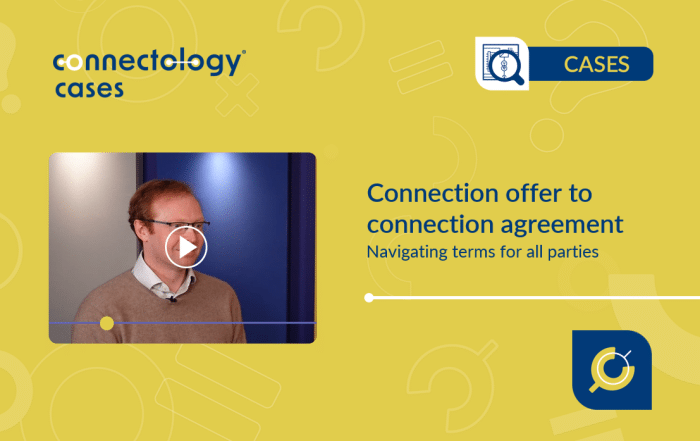
So this project was a draft connection agreement review. This was for a 33kV connected battery storage scheme. It was 12 megawatts in Scottish Power’s distribution network area.
Some of the primary problems that we came across for this project — first of all, there was some really unclear terms for disconnection around when the project would be disconnected, for how long, and why the DNO wanted to disconnect the project. It was very much what I would classify as a blank cheque. We can disconnect you whenever the system is running abnormally and no reason specified.
00:37 – What we found
There were some technical errors that were in there which, had it gone through, would have resulted in the wrong settings being applied for the project, which could have resulted in the project being disconnected or constrained unnecessarily for no good reason. That was spotted, it was updated by the DNO and reissued to make it far more clear and effective. And we’ve even gone one step further with the DNO, discussing what happens if this happens — what’s the next stage? When would the network operator undertake reinforcement? How do we manage that risk in the long term?
There was an incorrect capacity detail within the offer, which risked that when the project was connected and energised it would have its full export capability. But if the DNO asked the customer to amend their power factor, the connection agreement as it was written would mean that the customer wouldn’t be able to export at their full rated megawatts and would have to reduce it because it was limited by its MVA capacity for the project. And ultimately that could reduce revenue.
Whilst the DNO wouldn’t have meant for that to be in effect, by updating the connection agreement at this stage, it makes it very clear that if the DNO requests power factor be changed in the future — which they can, in line with G99 — it means that the customer’s revenue stream will be protected and they’ll end up making the same amount of money from the project, which is what the DNO would have intended.
There were some fairly unfair obligations based on the customer in this instance. So we wanted to make sure that the obligations imposed on the customer were necessary, that they were fair, and they were reflective of what the DNO needs to do to operate a safe and efficient distribution network.
And there were a few unusual commercial terms included in there, some of which were not particularly relevant for this customer. So it made sense for us, the customer and the DNO to be fully aware of what commercial terms were in there, where they applied, where they didn’t, and to agree with the customer whether they wanted to sign that agreement with these unusual terms in place.
02:40 – Where the project stands
For this project so far, the DNO has already responded on the initial connection agreement review with the points. We’ve already received a new version — it’s dramatically improved. Some of the really key, basic, important elements are coming through. The DNO has been working through the remaining points because they involve a raft of different technical and commercial departments.
The developer now better understands the elements and the risks of the connection agreement. They’ve asked us to undertake an additional piece of work so we can quantify the risk in a slightly clearer way for them, so they can build that into their financial model. But we’re well on the way of getting an updated connection agreement in place that is much more effective for the project.
03:22 – Why this matters
If you enter into a contract which has suboptimal commercial terms within that offer, you could end up with a scenario where you have a reduced revenue stream, you have less export under certain circumstances, you can be turned off more than you should be and more than you need to whilst you’re in the operational stage.
Fixing the terms and conditions before it’s signed is the right time to go through and do that, because often if you don’t do it at the very start, then you end up having to go back and renegotiate at a later stage. It takes a lot more time and effort, and before you’re able to go through and update that connection agreement, you’ll have lost revenue — and often it wouldn’t be spotted until it becomes an issue, and then you’re losing revenue.
04:11 – Key takeaways
So the key takeaways from this project are: connection agreements very rarely mirror exactly the connection offer, and even if they do, there is a risk that the connection offer should have been updated over time to account for changes in the network that have happened or changes in the regulation.
We would highly recommend doing the review early. It allows time for the dialogue between the DNO and to get the changes agreed without feeling the pressure of having to sign this document to get the project connected with terms that are suboptimal.